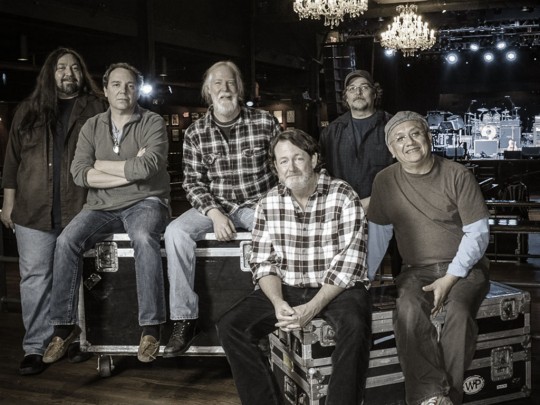
27 years ago this week, a singer everyone called J.B., a bass-playing future journalism school . . . dropout and a guitarist nicknamed Panic for his bouts with anxiety went looking for a drummer for their next gig.
After striking out with the usual suspects around Athens, Georgia, the three friends made an eleventh-hour call to a high-school band mate of the guitar player living in Atlanta, thinking he might still have his kit handy.
A few days later, Todd Nance rolled up to the house at 320 King Avenue shared by John Bell, Michael Houser and David Schools in an old, beat-up white Maverick, his drums crammed into the back. After a night of rehearsing, the new quartet hopped onstage together for the first time the next day at the old Mad Hatter Ballroom to play a short set that opened with the Buffalo Springfield classic “For What It’s Worth.” Widespread Panic was born.
Within the year, Domingo “Sunny” Ortiz, a drummer new in town from Austin, Texas, began turning up at their regular Monday night gigs at the Uptown Lounge and never left. As weekly gigs morphed into regional tours, the band began to forge a sound unto themselves, a combination of Houser’s unorthodox guitar playing, Bell’s coarse growl, Nance’s rock-steady drumming, Schools’ lead bass playing, Ortiz’s multi-textured percussion coupled with a collective commitment to playing original songs from the outset and a willingness to walk the improvisational high wire night after night.
Landslide Records came calling and Space Wrangler, Widespread Panic’s debut album, dropped in September 1988, the first copies of which, were hand-delivered to the band by Col. Bruce Hampton, an area shaman, bandleader and early mentor. Former Dixie Dreg T Lavitz manned the keyboards for the band’s self-titled follow-up released on Capricorn Records in July 1991, but it really wasn’t until John “Jojo” Hermann a native New Yorker-turned-Mississippian equally snapped by the likes of Professor Longhair and Terry Adams – claimed the chair the following spring that the band felt like a true ensemble. With a new songwriter, vocalist and worthy onstage foil in Hermann in the fold, the band’s lineup was set.
Over the next two decades, Widespread Panic released nine more studio albums and sold more than three million records, building a loyal following on the road beginning in dingy dive bars across the South and eventually headlining nearly every major U.S. music festival and selling out some of the world’s most prestigious venues. No artist has more sold-out concerts at Colorado’s Red Rocks Amphitheater, and their headlining appearance at the New Orleans Jazz & Heritage Festival set the single-day attendance record. The celebration for their first live album, Light Fuse, Get Away, drew more than 100,000 fans for a free show in downtown Athens and is still considered one of the largest CD-release parties in music history.
Click here to read more
By 2002, the band was one of America’s best and most sought-after rock acts, but rock ïn roll fairytales inevitably take a tragic turn. Michael Houser, Panic’s founding guitarist and inscrutable core, developed pancreatic cancer. The guitarist remained rooted at stage right until a few weeks before his death, delivering a spine-tingling, tear-jerking performance for the band’s headlining spot at the inaugural Bonnaroo Arts & Music Festival. Eight weeks after leaving the road, Houser was gone, taking with him a unique musical signature that fans affectionately dubbed The Lingering Lead. An era was over.
At the behest of their late guitarist, the remaining band members returned to the road, enlisting several friends to share the stage and help heal the void left by the irreplaceable Houser. It wasn’t until the summer of 2006 – when John Bell placed a call to an old friend to see if he might be interested in joining the band – that the wheels were put in motion for a new chapter in Widespread Panic’s history to begin.
Jimmy Herring was no stranger to Widespread Panic when he got the call inviting him to join the band. A veteran of the Atlanta music scene, Jimmy first crossed paths with the band in the late ’80s as the lead guitarist for Colonel Bruce Hampton and the Aquarium Rescue Unit.
From the first flurry of notes at his very first show with the band the opening night of a four-show run at Radio City Music Hall that kicked off the band’s 2006 fall tour, Herring has re-energized Widespread Panic in the best way possible: by restoring a signature guitar sound to their music, returning a sense of balance to their ensemble and enabling the band to continue to incite, amaze and move people closer to joy.
Nothing gold can stay, and no band understands that lesson better than Widespread Panic, but with Herring now in his seventh year in the fold and the band fresh off a ten-month hiatus and ready to roll, there’s a palpable sense of renewed purpose and commitment and a rejuvenated enthusiasm within the band.
That vibe, the feeling that anything can and may happen, is back with Widespread Panic. And it feels good.
Learn More
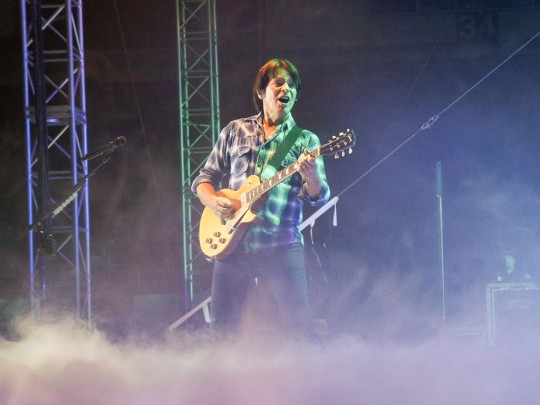
Before John Fogerty wrote a song for everyone — and the man has written many of popular music’s . . . most timeless standards like “Proud Mary,” “Fortunate Son,” “Born On The Bayou” and “Who’ll Stop The Rain” to name just a few — he first wrote songs for himself.
“Every now and then, I did try and write a song for everyone, but it would all start because I would feel something deeply and personally that would mean a lot to me,” Fogerty explains today. “Something in the world would strike me as being bad or tragic or unfair like in “Fortunate Son” and so I would get pissed off in a way that was very personal. Then as I was in the writing process, I would try to make the statement larger than just myself, and so in some small way, some songs became universal. But it wasn’t ever calculating. I couldn’t write commercials and jingles. I just began to think of ways to make the songs larger than myself, and the songs just kept growing.”
Wrote a Song For Everyone is a testament to the fact that the songs written by John Fogerty over the past forty-five years continue to speak in a powerful way to generations of music makers and music lovers. The stellar result is a heartfelt celebration of the impact Fogerty’s iconic songbook that find Fogerty working together with some of the most acclaimed and popular artists in music today. As Fogerty explains, “Writing songs can be very private, but making music is best made with other people. And on this album, I’ve had the honor of making music with many of my favorite people in music now.”
Learn More
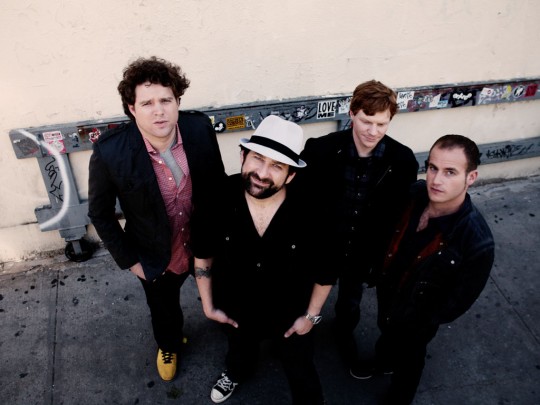
With nearly twenty years of history together as a band, The Disco Biscuits are innovators of the . . . “trancefusion” movement in modern rock. That said, they’re not the same band they were when they began in 1995 at the University of Pennsylvania. They still remain rock pioneers whose soul belongs as much to marathon dance parties as it does to live improvisational journeys. They still employ emerging technologies to help them create music that is 100 percent human although, perhaps, not entirely of this earth.
Bill Kreutzmann & Mickey Hart are known to Vibes fans as the beating heart of The Grateful Dead. Besides performing as The Rhythm Devils, Kreutzmann, the steady hand behind the kit – has also performed with his own trio, The BK3, as well as with another band called 7 walkers. Hart has toured with The Mickey Hart Band or The Rhythm Devils on and off since 1996. Together, they’ve been the foundation of rhythm and percussions, rising above and beyond most rock drum stereotypes with various excursions of percussion and rhythm.
With only select shows scheduled for 2014, when The Disco Biscuits take the stage, it is not to be missed. Add in this amalgamation of beat and you have a sweet blend of trance heavy dance rock and globe spanning, tribal rhythms and funk!
We couldn’t be happier to present this line up to the VibeTribe. This is one performance you’ll not want to pass up!
The Disco Biscuits
Mickey Hart
Bill Kreutzmann
Learn More

Forget trying to slap a label on Dispatch. You’re welcome to give it a shot, plenty of people have, . . . calling them at times a heartfelt acoustic trio, a wailing rock band, a devil-may-care funk act, but the band defies epithets at every turn. When they hear a description of their music, they just grab the closest instrument and switch things up in an effort to keep the stereotype-slingers at bay. It’s nothing personal, it’s just that they find inventiveness more interesting than playing it safe and churning out the kind of neat little ditties that people listen to for a week and then forget.
While Dispatch has managed to keep itself comfortably outside the chintzy glare of pop music’s spotlight, the industry nonetheless noticed them. Rolling Stone hailed Who Are We Living For? as one of the 10 best albums of 2001, and more than a few heads turned when that record debuted at 18 on Billboard’s internet sales chart (ahead of Sting!). For almost ten years, the three members of Dispatch cranked out music on their own label, Bomber Records, without help from a major record company. Propelled by the word-of-mouth and internet campaigning of their massive underground fan base, Dispatch has seen coast-to-coast sellouts at major venues like Roseland (NYC), the Fillmore (San Francisco), the Fillmore (Denver), Central Park (NYC), the Electric Factory (Philadelphia), the Fleet Pavilion (Boston), the 9:30 Club (DC), and many more.
But the concert to top all concerts was The Last Dispatch, a free musical farewell at the Hatch Shell in Boston in July 2004. When the three college friends decided to call it quits, over 110,000 fans from 25 countries mobbed the unsuspecting venue, making it the largest independent music event in history (outdrawing Phish’s swan song by 50,000 and the multi-band fest Bonnaroo by almost 20,000).
In July 2007, the trio reunited for “DISPATCH: ZIMBABWE”, an unprecedented three-night benefit at Madison Square Garden in NYC. Dispatch became the first independent band to sell-out the legendary arena (three nights no less) and more importantly, proved the healing power of music as the band and fans collectively raised funds and awareness for poverty stricken Zimbabwe.
Learn More

Talking Heads have been a musical inspiration for Lotus from the earliest days of the band’s . . . formation. Both bands evolved in similar fashion, starting as a basic two-guitar rock band, and subsequently expanding to include synthesizers, percussion, and a host of musical influences. Great grooves are at the heart of Talking Heads’ music – many of which pointed toward the basic beats found in dance styles that are still going strong today. For this special set, Lotus (and special guests) will be exploring the intersections between the music of Lotus and Talking Heads, rock and dance, and old and new.
Lotus has crafted a unique musical style outside of simple genre limitations. On a given weekend the band could be the only group with guitars at an all electronic music festival and then the next night crash a traditional rock festival with their dance heavy beats, synths and samples. Equal parts instrumental post-rock and electronic dance, the band’s distinguishing feature is the ability to maintain a decidedly unique musical voice and remain current while bucking passing trends.
No matter what the venue, the energetic joy and catharsis of a Lotus show is infectious. The band slowly built a devoted fan base through steady touring and the crowds have grown at an increasing pace. This grassroots growth has made the band in high demand for festivals including Bonnaroo, Outside Lands, Ultra, and Rothbury and earned the band sold out shows at the country’s premier theatres and clubs.
Learn More
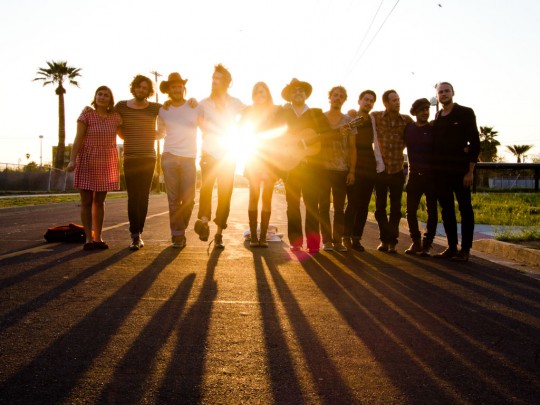
Edward Sharpe and the Magnetic Zeros formed in 2007 after singer Alex Ebert met fellow singer Jade . . . Castrinos outside of a cafe in downtown Los Angeles. In 2009 the 10 member troupe released their debut album Up From Below which featured the universally appealing hit “Home” as well as fan favorite’s “40 Day Dream” and “Janglin”.
The past few years have been spent constantly touring the world while winning over audiences at festivals like Coachella, Bonnaroo, Lollapalooza, Leeds, Austin City Limits and more. Their follow up album Here featuring “Man On Fire” and “That’s What’s Up” was released in May of 2012 and their recent self-titled third album was released in July of 2013 and feature’s “Better Days” and “Life Is Hard.”
Learn More
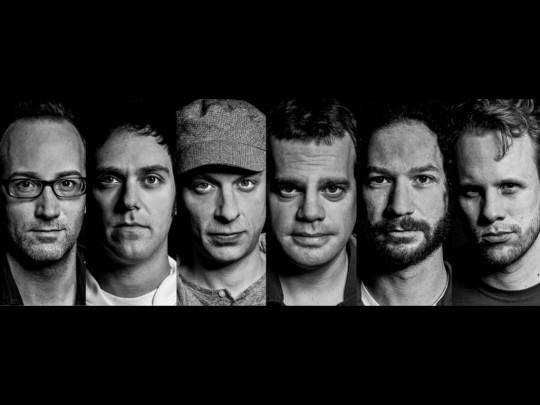
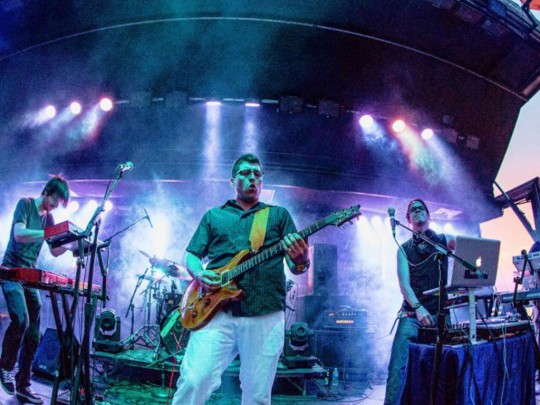
Fans who have followed Umphrey’s McGee for any period of time know that there are only two . . . guarantees: you never know what you are going to get, and Umphrey’s always delivers.
Umphrey’s McGee has been relentlessly innovative in both music AND fan relations for 16 years and counting. Whereas the band’s stellar reputation is based on marathon concerts that mix original, technically demanding tunes with complex epics and playful covers (ranging from Toto to Metallica), it has chosen the same kind of attention to melody, songcraft, and musicianship. This is the care that make artists stand apart. Umphrey’s chemistry, however, is something all its own, built upon a relentless live schedule of 100-plus shows a year, a solid base of musical training, and friendships that go back to when they walked in the shadows of the Golden Dome at the University of Notre Dame.
These days, the band plays for crowds from all over the United States and beyond. Incorporating a sophisticated mix of cutting-edge technology — including a state of the art light show — with meticulous attention to sonic detail, the band and crew intends to drop jaws and melt faces at each and every concert. Monthly podcasts, an extremely active presence on Facebook and Twitter, and digital “Easter Egg” hunts have led to a strong following even outside of the US, leading to successful international tours of Europe, Australia, and Japan, where fans screamed out song titles — in English.
Click here to read more
When it comes to experiencing Umphrey’s McGe to the fullest, the live concert experience is unparalleled. Special fan interactive events like the Stew Art series have redefined live music as we know it — with fans texting to choose the direction of the band’s set — while the four-quarter UMBowls (each quarter has a different interactive theme) have quickly become landmark events not to be missed. Another initiative unique to Umphrey’s McGee is the “Headphones & Snowcones” program, where fans are given the unique opportunity to experience UM’s pristine sound up close and personal. Attendees can have the soundboard mix piped wirelessly to their ears via high-end personal monitor systems and headphones. It’s an entirely new way to experience live music and another innovation from a band that is constantly finding new ways to put fans first. As Umphrey’s McGee continues to evolve and the band-to-fan relationship is constantly reinvented, the band stays ahead of the curve as they create events that no other band can offer, unique to an organization that is not afraid of anything except stagnation.
To date, Umphrey’s has sold over 3.3 million tracks online as every live show since 2006 is available via their live music portal UMLive.net. With a catalogue of seven studio albums and counting, and a series of yearly best-of compilations entitled Hall of Fame, Umphrey’s McGee continues to create new music through a writing process that never halts. The last studio release Death By Stereo (2011, ATO Records) was produced by sonic wizards Manny Sanchez (Smashing Pumpkins, Fall Out Boy) and Kevin Browning, whose deep knowledge of analog and digital gear has helped the band craft its sound for years.
The next release slated for Spring 2014 will offer fans an array of original music, some tracks familiar to fans who have heard them in the live arena, while others are unreleased and never heard before. This eighth studio offering from a band that never rests will once again prove that Umphrey’s McGee is here to stay.
Learn More
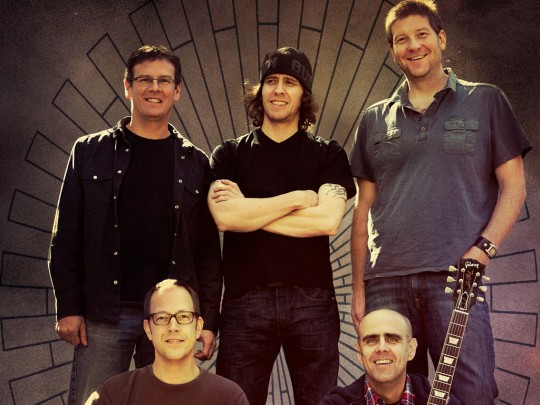
moe. is the preeminent progressive rock band on the music scene today, a quintet of world class . . . musicians, whose creative output equals that of their longevity. In a remarkable career that has touched three decades and produced a discography of 24 albums, the Sugar Hill Records recording artist of Al Schnier and Chuck Garvey on guitars and vocals, Rob Derhak on bass and vocals, Jim Loughlin on percussion and vibes, and Vinnie Amico on drums, continue to push the standard for performance art higher and further.
Whether touring around the globe, headlining music festivals, or sharing the stage with such diverse acts as the Allman Brothers, Dave Matthews Band, The Who, Robert Plant, Gov’t Mule, or Blues Traveler, among many others, what keeps moe. at the forefront of the music scene is not only the energy and vitality of their music and songwriting, but the showmanship in which it is delivered. Their music is clever, melodic, refined, filled with “ferocious guitar riffs” and “intricate rhythms” (Relix); their performances are entertaining, mesmerizing, and epic.
From their humble, inconspicuous beginnings as a local bar band in Buffalo, NY, to headlining Radio City Music Hall on New Year’s Eve, moe.’s journey has been one of hard work, perseverance, and dedication. Critical acclaim and a solid national and international fan base has resulted in a dedicated following that grows each year. Rolling Stone magazine named Chuck and Al among the top twenty new “guitar gods,” The pair have been featured in Guitar World and Modern Guitar, Jim and Vinnie in Drum!, and Rob in Bass Player. The renowned guitar play between Al and Chuck has become the stuff of legend. The exceptional vibe and percussion work by Jim is brilliant. The understated bass play by Rob is masterful. The seamless, efficiency of Vinnie’s drumming is extraordinary. Together, the five create a musical synergy greater than the sum of their parts.
Click here to read more
The news about moe. keeps getting better, too, in the studio and on tour. A new album, their second on Sugar Hill Records, is set for a 2014 release. It follows the critically acclaimed 2012 release, What Happened To The LA LAs, and the 2010 Smash Hits, Volume One, a rerecording of some of moe.’s most endearing classics. The band’s tour schedule is extensive, playing in venues, intimate and grand, from NYC to LA, San Fran to Atlanta, Chi Town to Bean Town, from Tokyo to Toronto, and across the Atlantic to Paris, Amsterdam, London, Hamburg, and Milano. Long a featured act at music festivals, they’ve performed and headlined at the likes of Bonnaroo, All Good, and High Sierra, in the US, and Fuji Rock Festival in Japan, and Burg Herzberg in Germany, to name a few; yet made time to promote and perform at their own festivals, Summer Camp, Snoe.down, and moe.down.
By all accounts, for this “legendary jam band,” as Rolling Stone described them, moe. represents rock and roll at its best. Welcome news for the moe. faithful and the band’s ever-expanding fan base. Even better news for the world of rock and roll, for moe. is just hitting their creative stride.
Learn More

While it’s a rare commodity for a band to tour as consistently as Slightly Stoopid, the group’s . . . diligent commitment to live music provides some insight into why it’s been a few years since the release of their last studio album. But on August 14, 2012, the Ocean Beach, California-based group, led by co-founders and multi-instrumentalists Miles Doughty and Kyle McDonald, will drop their latest studio effort, Top of the World. As heard throughout the disc, the layoff between albums has not affected the group’s penchant for cooking up the tasty fusion and massive groove that permeates Stoopid’s trademark sound.
‘We’re a touring act, and we’ve been on the road pretty much non-stop over the last decade,” explains Doughty. “It really came into play on the release of the new record. Our last studio record [Slightly Not Stoned Enough to Eat Breakfast Yet Stoopid] was about three and a half years ago. But with the band, we were starting families, we’d been on the road so much, we really didn’t have time to sit down and focus on actually recording it.”
Doughty also admits that the creation of the band’s own recording studio and rehearsal clubhouse, within the warehouse district of Mission Valley (just inland of Ocean Beach), certainly aided the creation of Top of the World.
Click here to read more
“In the past two years, we started our own studio, which really enabled us to make the record at our own pace, and to make the right record for us at this time in our career,” Doughty continues. “What’s nice about it is having our own environment to record in and analyze the music, and it really lets you keep an organic feel. For us, I feel like it’s a step into the next level, as far as understanding the process of recording, understanding the process of songwriting. We took everything that we’ve learned over the years and really put it into this record.”
Another key ingredient to what makes Top of the World so special is the inclusion of several musical guests. “It really kept that ‘family atmosphere’ for us,” says Doughty. “I think it really shows in the music„it flows. It’s like one of those records that feels like it’s one giant song. It keeps building and building. For us, we couldn’t be happier. Top of the World speaks volumes as to where the band is today; just lyrically and musically, we’re really happy with the direction.”
“We had G. Love, Angelo Moore from Fishbone, Don Carlos, Barrington Levy, Ian Neville from Dumpstaphunk, Tory Ruffin from Morris Day and the Time and Fishbone, and singer/songwriter Angela Hunte. We’ve been friends with G. Love for over 15 years, and we’ve been able to work together quite a few different times in the studio. It seems like second nature. Whenever you’re recording with G., it’s almost like you’re really just hanging out with your bro, and you happen to hit record. We’ve done so many shows together and so many studio sessions, it becomes second nature. Angelo Moore to me is one of the greatest frontmen to ever step foot on a stage. As a fan and out of respect, I try to do something with Angelo every time we have a record, really. If you listen to his lyrics, his vocal performance„I don’t know who could keep up with Angelo on stage. Don Carlos from Black Uhuru is one of the legendary reggae singers of all time, and we’ve had the pleasure of working with him the last few years.”
Riffing on some of the album’s highlights, Doughty says “I really love ‘Hiphoppablues,’ the song G. Love did. I love the song ‘Way You Move,’ Ian Neville did a great guitar line throughout the whole song. We worked with Barrington Levy on ‘Ur Love,’ he is a true architect of the dance hall! Definitely ‘Ska Diddy’ with Angelo„it’s a fun rant and shout out to a lot of the nooks and crannies we play across the country.”
Besides recording at their own studio, Slightly Stoopid has always been extremely hands on when it comes to their career, going back more than a decade to when they founded their own record label, Stoopid Records.
“We started Stoopid Records around 2000,” Doughty clarifies. “At that time, we were in transition as far as what we were doing with our records, and we thought it would be good to have our own independent label„like Sublime showed us back in the day with Skunk Records. What’s nice is we’ve had a following with the fans, where people understand that Stoopid Records is Slightly Stoopid and other bands we want to help break out.”
“For us, it was a big turning point, as far as having complete creative control over everything we do. That’s something big for this band„we want to make the music for ourselves and for our fans. We don’t really make music for someone in an office that tells us something needs to be there. We’ve always had a very organic, do-it-yourself attitude. I think it’s paid off in dividends.”
In addition to the arrival of Top of the World, Slightly Stoopid should be very busy for the rest of 2012. “This summer, we’re doing The Unity Tour with 311. That was really cool„those guys approached us about doing a tour with them. For the last five years, we’ve been headlining all the amphitheater tours, so it’s kind of nice that we’re going to co-headline with them. It’s a good chance to not only play for our fans, but to play for 311 fans and show them the new direction of the new record. After the summer tour, we’re going to do a fall tour and a winter tour, stay on the road as much as possible, promote the record, and keep making more music.”
Slightly Stoopid’s current line-up, featured on the Unity Tour 2012, consists of Doughty (guitar, bass, vocals) and McDonald (guitar, bass, vocals), along with Ryan “Rymo” Moran (drums), Oguer “OG” Ocon (congas, percussion, harp, vocals), C-Money (trumpet), Dela (saxophone) and Paul Wolstencroft (keyboards). Additionally, “unofficial 8th member” Karl Denson of Greyboy Allstars also lent his talents throughout Top of the World, and is joining the band on tour this summer.
Nearly two decades into their ongoing metamorphosis, Slightly Stoopid continues to progress into new musical territory, defining their signature sound even further and creating a contagious feel-good vibe. An entire subculture has grown around the social statements the band makes with their music„and it’s been done entirely on their own terms.
No wonder they feel like they’re on Top of the World.
Learn More
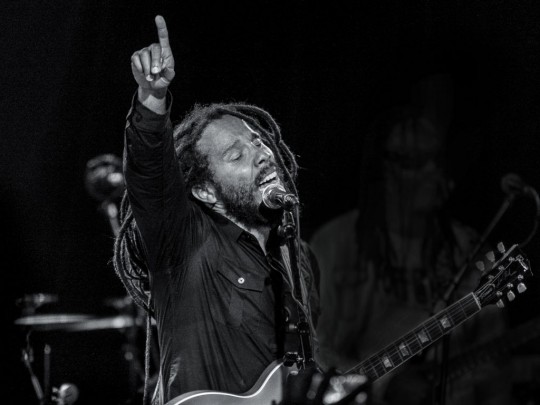
For Ziggy Marley, his latest vehicle of expression the album Fly Rasta, represented a galactic sonic . . . journey.
The trip began in early 2013 with a handwritten note by the six-time Grammy Award winner (with his most recent being the 2014 Best Reggae Album Grammy for Ziggy Marley In Concert). He sat in his home recording studio, took out a scrap of paper, and began to think about what would become his fifth solo studio album.
The concept was simple: make a record that was true to himself, and expanded the territories of the traditional reggae sound by exploring new musical spaces. He had brought strands of other genres into his previous albums, but now he was looking further into the musical universe, like the deep-space eye of the Hubble telescope.
Ziggy began work in Spring 2013 and enlisted producer Dave Cooley to join him on the adventure. Recording began shortly thereafter with the help of friends old and new, including The Melody Makers (sisters Cedella Marley and Sharon Marley, and singer Rica Newell); drummers Stephen Ferrone (Tom Petty), Brian MacLeod (Sheryl Crow), Rock Deadrick (Ben Harper) and Motown’s legendary James Gadson; guitarists Lyle Workman (Sara Bareilles), Takeshi Akimoto (Taj Mahal) and Ian “Beezy” Coleman (Burning Spear); bassists Dave Wilder (Norah Jones), Guy Erez (Karmina), Abraham Laboriel (Paul Simon) and Pablo Stennett (Willie Nelson); and keyboardists Zac Rae (Lana Del Ray), David Palmer (Goo Goo Dolls), George Hughes (Sarah Vaughan), Mike Hyde (Burning Spear) and Brian LeBarton (Beck).
Click here to read more
Fly Rasta, scheduled for release April 14, fulfills Ziggy’s mission by marrying his own distinctive reggae sound with elements of psychedelica, rock, funk, soul and pop, exploring further musical zones with the addition of sitar, tabla and taiko drums. “I’m looking to push the envelope, to challenge myself,” Ziggy explains. ” I have always wanted to travel far beyond the realms of expectations.”
Equally ambitious in its lyrical themes taken from Ziggy’s own life experiences and emotions Fly Rasta is a call to empowerment, enlightenment, freedom and, as with many of Ziggy’s songs, the higher power of love. It’s also a call to action for the planet Earth. A packet of wildflowers is included in every CD, encouraging fans to connect with nature and grow something beautiful. Ziggy is also partnering with several environmental organizations, including COTAP (Carbon Offsets To Alleviate Poverty), which will assist in offsetting the “carbon footprint” of his upcoming world tour.
The album opens with “I Don’t Wanna Live on Mars,” which sets the tone both musically and thematically as a love song to his “woman” Earth. From its Mission Control countdown it breaks into an infectious reggae beat amped up by power chords, immediately distinguishing the album as a fresh musical amalgam.
The album’s title track “Fly Rasta” offers an uplifting reggae anthem featuring reggae innovator and legend U-Roy, the strong backing vocals of The Melody Makers and an infectious horn section. A celebration of Rastafarian culture and a tribute to reggae’s musical roots, “this is a song I’ve been holding on to for nearly 20 years,” says Ziggy.
In the emotional ballad “Lighthouse,” Ziggy offers strength as a beacon to loved ones. The tone brightens on the sitar-laced “Sunshine,” a reminder of hope even in adversity “Moving Forward” weaves a similar message of conquering pain and hurt, yet in a progressive rock-flavored vehicle propelled by Takeshi Akimoto and Ian” Beezy “Coleman’s angular guitar work.
While the introspective “You” utilizes the second-person to convey what is a song about finding your true self, “So Many Rising” speaks of common causes, stripping it down to acoustic guitar and hand drum in a reproach of greed, corruption, climate change and eroding freedoms. The mid-tempo “I Get Up,” a call for feeling good and perseverance, finds Ziggy singing with his sister Cedella, who arranged background vocals on the entire album.
With a rock cadence, a nod to John Lennon and a slide-guitar break worthy of George Harrison, “You’re My Yoko” is the album’s direct praise for Ziggy’s wife Orly Marley (“oh your sweet inspiration”). The theme of love culminates Fly Rasta in “Give It Away,” echoing the legacy of Ziggy’s previous love songs, including “Forward to Love” and “Love Is My Religion” with the words ” Only if we give it away can love be love .”
Beyond the recording studio and live stage, Ziggy Marley remains a vibrant, multimedia force. On radio he continues to host a monthly “Legends of Reggae” program on SiriusXM’s The Joint (Channel 42), featuring some of the best reggae tracks from the last five decades. Following his comic book project Marijuanaman, he published a children’s book, I Love You Too, and narrated an interactive app, based on the song from his album Family Time. He also continues to expand his new venture, Ziggy Marley Organics, a line of organic, non-GMO products, from Coconut Oil to Roasted Hemp Seeds, currently available in over 1,000 stores nationwide.
A native of Kingston, Jamaica, Ziggy Marley and his siblings first sat in on recording sessions with his father’s band, the legendary Bob Marley and the Wailers, when he was ten years old. Later, Ziggy joined with brother Stephen and sisters Sharon and Cedella to become The Melody Makers, allowing him to craft his own soulful sound which blends blues, R&B, hip-hop and roots reggae. The Melody Makers earned their first Grammy (Best Reggae Recording) for Conscious Party (1988), their third album, produced by Talking Heads Chris Frantz and Tina Weymouth, which included the hit songs “Tomorrow People” and “Tumbling Down.”
Their subsequent albums include the Grammy-winning One Bright Day (1989), Jamekya (1991), Joy and Blues (1993), Free Like We Want 2 B (1995), Grammy winner Fallen is Babylon (1997), Spirit of Music (1999) and Ziggy Marley & the Melody Makers Live, Vol. 1 (2000), featuring some of their biggest hits, as well as a cover of Bob Marley’s “Could You Be Loved.” While selling millions of records and selling out numerous concerts, Ziggy Marley and The Melody Makers never lost sight of their foundations in faith, fellowship and family.
After two decades as the driving creative force behind The Melody Makers, Ziggy’s first solo tour came in Summer 2002, on the 23-city Jeep World Outside Festival, joining such artists as Sheryl Crow, Train and O.A.R. The following year saw the release of his debut solo album, Dragonfly, followed by 2006’s Love Is My Religion, a Grammy winner that further explored personal, social and political themes amid a fragrant mix of roots reggae, traditional rock, African percussion and other varied musical elements. He won his fifth Grammy Award, this one for Best Musical Album for Children, for Family Time, a 2009 collection of reggae-inflected, family-oriented songs. His last studio album, Wild and Free, with it’s pro Hemp and Marijuana title track soared to the top of the Billboard Album Chart in 2011 to become one of the year’s #1-ranked reggae albums. Ziggy recently added an Emmy Award to his mantle for the 2013 children’s song “I Love You Too,” heard in the Disney Channel series “3rd & Bird!” along with his sixth Grammy, in 2014, for Ziggy Marley In Concert.
Involved with a breadth of charities, Ziggy leads his own, U.R.G.E. (Unlimited Resources Giving Enlightenment), a non-profit organization that benefits efforts in Jamaica, Ethiopia and other developing nations. The charity’s missions range from building new schools to operating health clinics to supporting charities like Mary’s Child, a center for abused and neglected girls.
Learn More
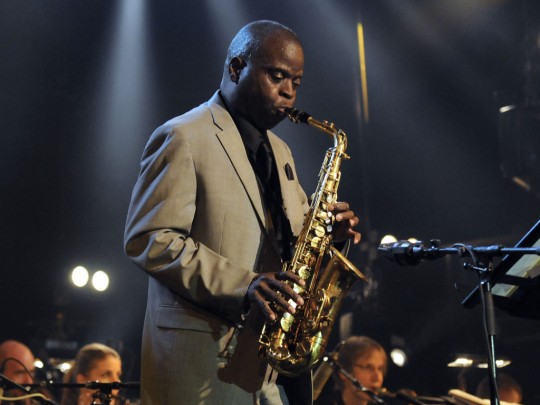
Maceo Parker: his name is synonymous with Funky Music, his pedigree impeccable; his band: the . . . tightest little funk orchestra on earth.
It’s fairly common knowledge that Maceo has played with each and every leader of funk, his start with James Brown, which Maceo describes as “like being at University”; jumping aboard the Mothership with George Clinton; and his ongoing part in Prince’s tours. He’s the living, breathing pulse which connects the history of Funk in one golden thread. The cipher which unravels dance music down to its core.
“Everything’s coming up Maceo,” concluded DownBeat Magazine in a 1991 article at the beginning of Maceo Parker’s solo career. At the time Maceo was a remembered by aficionados of funk music as sideman; appreciated mainly by those in the know. For the last two decades Maceo Parker has been enjoying a blistering solo career, building a new funk empire; one that is both fresh and stylistically diverse. He navigates deftly between James Brown’s 1960’s soul and George Clinton’s 1970’s freaky funk while exploring mellower jazz and the grooves of hip-hop.
His collaborations over the years have included Ray Charles, Ani Difranco, James Taylor, De La Soul, Dave Matthews Band and the Red Hot Chilli Peppers. His timeless sound has garnered him a fresh young fan base.
It is almost impossible to separate which came first, Maceo or the funk. The amazing P-funk Parker has been at it with his legendary sound for time that dates back to the 1960’s. That’s when Maceo and his drummer brother Melvin climbed on board the James Brown funky soul funk train. It wasn’t long before James coined the solo summoning signature, “Maceo, I want you to Blow!”. To most musicologists it’s the musically fertile group of men from this period of James Brown’s band who are recognized as the early pioneers of the modern funk and hip-hop whose sounds we still jump to in the present day.
[learn_more caption=”Click here to read more”]
Maceo grew to become the lynch-pin of the James Brown enclave for the best part of two decades. – his signature style helped define James’ brand of funk, and the phrase: “Maceo, I want you to Blow!” passed into the language. He’s still the most sampled musician around simply because of the unique quality of his sound. There would be other projects and short hiatuses during his on-off time with The Godfather, including a brief spell overseas when he was drafted, and in 1970 when he left to form Maceo and All the Kings Men with some fellow James Brown band members (the two albums from this period are on a constant reissue cycle even some thirty years later.) It was Maceo’s Uncle the front man for a local band; the Blue Notes, who was Maceo’s first musical mentor. The three Parker brothers (Maceo, Melvin and trombonist Kellis- later to become Professor of Entertainment law at Columbia University) who formed the “Junior Blue Notes.”. When Maceo reached the sixth grade the Junior Blue Notes were brought by their Uncle perform in between sets at his nightclub engagements. It was Maceo’s first experience of the stage and one that started his love affair with performing an love which has increased rather than diminished with time. Maceo grew up admiring saxophonists such as David “Fathead” Newman, Hank Crawford, Cannonball Adderley and King Curtis. “I was crazy about Ray Charles and all his band, and of course particularly the horn players”. By the age of 15, Maceo had forged his own style on the tenor sax. “I thought about ‘Maceo Parker plays Charlie Parker’, and then I thought how about ‘Maceo Parker plays Maceo Parker’, what would it be like to have young sax players listening to me and emulating my style of playing”. Thus the “Maceo sound” we know so well was born. In the mid ’70’s Maceo hooked up with George Clinton, and the various incarnations of Funkadelic, Parliament and Bootsy Collins. He now had worked with the figure heads of Funk music at the height of their success. From the breathtaking shows of James Brown to the landing of the Mothership, Maceo has been there: as close as it gets to some of the most exciting moments in musical history, delivering his sound as a constant point of reference.
In 1990 the opportunity came for Maceo to concentrate on his own projects. He released two successful solo albums: Roots Revisited (which spent 10 weeks at the top of Billboard’s Jazz Charts in 1990) and Mo’ Roots (1991. But it was his third solo album, Maceo’s ground breaking CD Life on Planet Groove, recorded live in 1992 which soon became a funk fan favorite. Planet Groove also served as a calling card, boosting Maceo’s contemporary career as a solo artist for a college aged audience, and bringing into being his catch phrase “2% Jazz, 98% Funky Stuff.” And so began Maceo’s relentless headlining touring. Bringing his top notch, road-tight band and superlong shows to people all over the world. “I feel it’s my duty as an artist to go as many places as I can, especially if the people want it.” says soft spoken North Carolina native. He doesn’t come out on stage in a diaper or a velvet swirling cape, no giant spaceships or 50 person entourages, nothing except the core of his musical soul which he lays open every time he blows his horn.
In 2003, after several years as Band Leader for the Rhythm and Blues Foundation Awards Maceo received a Pioneer Award from the Rhythm and Blues Foundation for his contribution as a sideman to the genre of R & B.
Since 1999 Maceo has participated in some of Prince’s groundbreaking tours when not on the road with his own group, and continues to do so as a special guest when his own schedule allows. Maceo’s albums Funk Overload, Dial M-A-C-E-O and Made by Maceo entered the top 40 in the European charts upon release. Dial M-A-C-E-O features guest spots from the Mistress of folk music Ani DiFranco, Prince, and a quite different James from the one we have come to associate with Maceo: James Taylor, while School’s In from 2005 is about as Funky as a studio album can be.
At the beginning of 2007 Maceo had a chance to fulfill one of his dreams: working with a Big Band. With Grammy Award Winners the WDR Big Band from Cologne Germany, he broadcast and performed a live series of shows paying tribute to Ray Charles and released the album Roots and Grooves, a live recording taken from these shows which also features Dennis Chambers and Rodney “Skeet” Curtis. The album received huge critical acclaim, and Maceo has followed up with a recording to be released in 2012: Soul Classics. Along with WDR Big Band the album features drummer Cora Dunham Coleman and bassist Christian Mcbride.
In July of 2012 Maceo was presentedwith Les Victoires du Jazz in Paris: a Lifetime Achievement Award for his contribution to music. The same weekend he was presented with an Icon Award at the North Sea Jazz Festival in Rotterdam, with the following inscription “Maceo Parker, a music-maker and world-class performer for almost fifty years, distinguishes himself through exceptional musicality and craftsmanship. The inspired and indefatigable saxophonist has made an indelible mark on soul, funk and jazz.
The unique sound of James Brown owes a sizable debt to the talent and inspiration of Maceo Parker, and Brown recognized it openly. Parker’s name found its way into Brown’s lyrics: “Maceo, blow your horn!” Prince also tips his hat to Parker referring to him as ‘The Teacher’. Maceo Parker has not only made an incredible amount of music, he has put his signature on a huge variety of musical genres. Through his partnership with soul and jazz artists like James Brown, George Clinton en Bootsy Collins as well as pop formations like Living Colour, Bryan Ferry, The Red Hot Chili Peppers and The Dave Matthews Band, Maceo Parker has entertained a wide audience with his unique saxophone sound. Parker’s music is a major source of inspiration in the hip hop world. He is one of the most sampled musicians in the world.
Maceo Parker’s music integrates a range of genres from soul, funk and jazz to rhythm and blues while maintaining respect for tradition. As saxophonist, singer, composer and band leader, Maceo Parker has distinguished himself through a wide array of projects, CDs, concerts and international festivals. Parker regularly performs with Prince, often accompanied by Candy Dulfer. He is at his best on stage, where he shows his boundless energy and passion and his ability to captivate audiences with his sound. All the qualities of an icon unite in Maceo Parker, and the jury is proud to present him with the 2012 Radio 6 Icon Award.”
“Given Parker’s sense of groove invention and the evergreen emotional power of Charles’ chestnuts like “Busted” and “Hit the Road Jack,” anyone might have expected this to be a dream match. But it’s more than that because Parker also sings with a gravelly, Charles-like perfection on these two songs, and even more poignantly on “You Don’t Know Me,” “Margie,” and a magically moody “Georgia on My Mind.” Charles may have been declared deceased in body in 2004, but he lives again through Parker in haunting yet wonderful ways” – All Music Guide
“Maceo put a complex funk spin to the famous Parker name playing his horn more like a drum than a melodic instrument. The result is an insanely percussive style, which forces everyone within ear shot to dance like a giddy geek. For sure no one plays the alto saxophone like Maceo Parker, and most likely no one ever will again. Never ignoring melody Parker woos us sweetly on one tune, only to make us jump out of our skin the next with Funkalicious ferocity. The bottom line…if you want to dance with members of the opposite sex without asking them too, go to a Maceo Parker show. Once there, you suddenly realize this is one of the reasons why you’re alive on this planet…to be taken to a place where your mind stops thinking as you listen, move, and experience pure joy”. – Dave Todoroff
“He’s no bebopper, reborn or otherwise. His roots are the church and the blues… his sound is joyful, cutting ribbon of light and heat burnished by grit and soul. His riff-based attack is melodic, unraveling and re-weaving themes rather than running chords, and primarily rhythmic, relying on finely-shaped nuances of timing and displacement to communicate – kinda like his longtime boss’ vocals, amazingly enough.” There’s no doubt about it, “There’s only one Maceo.”- Gene Santoro Downbeat Magazine
“When people talk about legends they mean ‘they’re done, but boy did they do good’ when I think of Maceo Parker I think of legendary funk master and horn player, but not ‘legend’ in the term that he’s done. He’s still doing it. And that to me makes a really legendary person.” – Ani DiFranco
[/learn_more]
Learn More
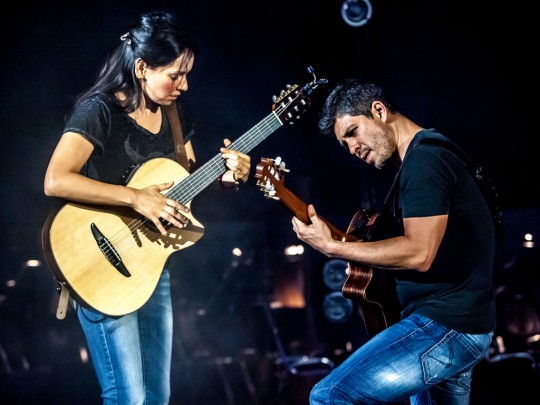
Internationally acclaimed Mexican acoustic rock guitar duo Rodrigo y Gabriela are back on the road . . . again in 2014, bringing their unique instrumental blend of metal, jazz and world music to audiences all over the US.
Rodrigo Sanchez and Gabriela Quintero have been playing together for more than fifteen years. First as young thrash metal fans in their native Mexico City, then as innocents abroad and street musicians in Dublin, Ireland at the turn of the millennium, and finally as the globe-straddling, film-scoring, record-breaking artists they are today.
Known for exhilarating live shows, Rodrigo y Gabriela have won the hearts of music lovers from the haciendas of Cuba to the Hollywood Bowl and festival fields of Europe, as they continue to weave their unique six-string magic. The extraordinary interplay between Sanchez’s fiery lead lines and Quintero’s phenomenal rhythmic battery is truly universal.
The duo has reloaded their arsenal following the April 2014 worldwide release of “9 Dead Alive”, their first studio album in five years. The new songs are intimate, the playing intuitive, and the results are spectacular, bursting with melodic energy and rhythmic invention.
Recorded at their Pacific Coast hideaway in late summer, the album captures the warmth and spontaneity of two great musicians riffing and jamming together, perfectly distilled into 9 new songs teeming with desire, elegance and gusto.
With career sales in excess of 1.5 million albums, blockbuster movie scores, and sold out tours worldwide, Rodrigo y Gabriela have certainly made their mark. Their appeal is boundless, their scope limitless, and the music timeless; clearly, we have only begun to see what this duo is capable of.
Learn More
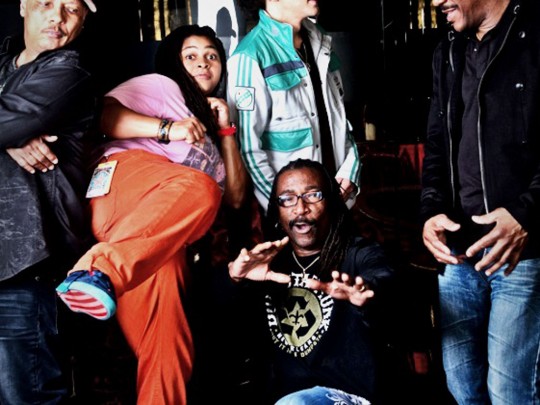
A decade evolved from their debut at 2003’s New Orleans Jazz & Heritage Festival, Dumpstaphunk . . . offers fans an unforgettable live experience steeped in the Big Easy tradition of a good time. The quintet features Ivan Neville on vocals, B3 and Clav, the double bass attack and soulful voices of Tony Hall and Nick Daniels III, Ian Neville on guitar, and the monster addition of Nikki Glaspie on drums and vocals.
From annual performances at New Orleans’ Jazz Fest — “The colossal low end and filthy grooves they threw down from the Gentilly Stage must have set a Jazz Fest record for baddest bass jams ever.” (Bass Player Magazine, 2012) — to music rooms and festivals across the nation (Bonnaroo, Wakarusa, All Good, High Sierra, Hangout, Jam Cruise and Outside Lands to name a few), Dumpstaphunk continues to spread an unmistakably New Orleans groove with hard-hitting performances that dare listeners not to move.
“We always keep the spontaneity going, that’s something I love about this band,” says Ivan. “We can funk it out with the best of them, but we also like to showcase how all sorts of music can come together and push the boundaries of what funk music is.”
Dumpstaphunk’s summer 2013 release, Dirty Word, re-imagines their genre, holding true to the opinionated, vintage funk of Sly & the Family Stone and Parliament Funkadelic, but with a modern edge that forays into gospel, blues, second-line, R&B and straight-up rock n’ roll. True to New Orleans tradition, Dumpsta’s friends and family Troy “Trombone Shorty” Andrews, Rebirth Brass Band, Skerik, the Grooveline Horns, Art Neville, Ani DiFranco and Flea of the Red Hot Chili Peppers kick the Dirty Word sessions up a notch.
[learn_more caption=”Click here to read more”]
Ivan continues, “The whole record speaks to the righteousness of music. We’re not necessarily telling a specific story, but expressing how music makes things right for everyone in their own way. Our fans can feel that vibe and let it take them wherever they need to.”
“We just hope to spread the good word through funk,” adds Nikki Glaspie. “If we can create an escape, give people a reason to get down and forget their problems, then we’re doing what we set out to do.”
[/learn_more]
Learn More
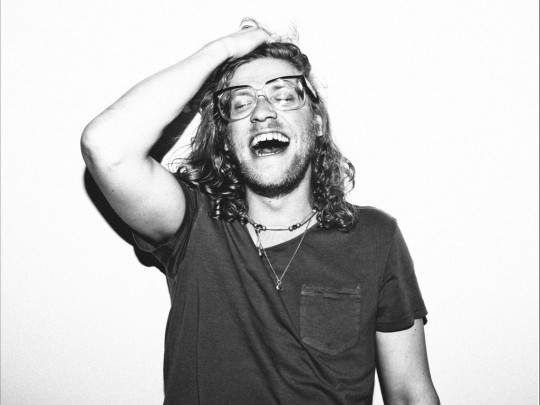
While the buzz was building in early 2014 about the Internet of Things, Allen Stone was recording in . . . his rustic Washington State cabin and extolling the virtues of an old-fangled kind of connection, the one that exists between people playing music together. The 26-year-old soul singer, praised as a “pitch-perfect powerhouse” by USA Today, was working on the follow-up to his self-titled breakthrough album, which he released digitally on his own stickystones label in late 2011. Sure, he acknowledges, he could have written and recorded his new set of songs alone on a laptop, but that wouldn’t have been nearly as much fun.
“I’m a social person and, to me, the greatest energy that you can cultivate is a collaborative energy. It feels better when you’ve got somebody to bounce ideas off of,” explains Stone.
While he’s not keen on creating music with computers, Stone nevertheless considers technology to be an enormous blessing. In fact, he might have never met his co-producer, Swedish musician Magnus Tingsek, if he hadn’t been digging around online for new music.
“I was like his number one fan for three years,” recalls Allen. At that point, things started exploding for Stone. His self-titled album shot into the Top 10 of Billboard’s Heatseekers chart and entered the Top 5 of iTunes’ R&B/Soul charts shortly after its release. Soon the unsigned artist was appearing on shows like “Conan,” “Jimmy Kimmel Live,” “Last Call with Carson Daly” and “Live from Daryl’s House.” NPR’s Ann Powers hailed the album as “meant for those of us who like our R&B slightly unkempt and exceedingly feelingful” and Forbes ran a feature focusing on his remarkable success as an independent artist. The New York Times’ Jon Pareles praised Stone’s live show, noting, “his music reached back four decades to the late 1960s and early ’70s, when songwriters like Stevie Wonder, Marvin Gaye, Donny Hathaway and Bill Withers brought introspection and social commentary to soul music.”
[learn_more caption=”Click here to read more”]
A partnership with indie label ATO Records, which later released the album physically, opened new doors. Stone was voted one of mtvU’s “Freshman 5” and named a VH1′ “You Oughta Know” artist. He opened for Al Green and Dave Matthews and performed on “Late Show with David Letterman,” “The Ellen DeGeneres Show” and “The Tonight Show with Jay Leno.”
With an 85-date headline tour planned and two out of three openers selected, Stone asked his manager, “Why don’t we see if Tingsek will come?” Tingsek, who had never toured outside of Scandinavia, agreed and the two became good friends as they traveled across North America and throughout Europe.
“My number one joy is playing live, so when I write records I really just think of what song I could write that would be really fun to play live,” says Stone. “Basically my job is to throw a party for people every night when we’re on tour.”
The non-stop pace of touring and promotional appearances makes it tempting to “set the cruise control a little too high,” Allen notes, which can take its toll over time. After doing nearly 600 shows in two years, Stone was ready to turn from touring to recording. He moved from Seattle back to his hometown of Chewelah, WA, population 2,606.
“To find the balance I was looking for, I needed to move out to the middle of nowhere, where I have no distractions whatsoever,” he says.
As he considered who he might like to collaborate with, Tingsek came to mind. Stone flew to Malme, Sweden in November of 2013 and, after just a day in the studio with Tingsek, he knew it was the right pairing.
“Magnus is like Prince, he plays everything! He’s like one of those Swiss Army knife musicians,” says Stone. “He hears music completely different than I do. I’m more like a classic soul/classic blues kind of singer and he is able to hear music in this new, weird, disco jazz nuance that totally challenges me to broaden my ear and my vocality.”
They wrote and recorded some tracks in Malm_ and, in early 2014, reconvened in Chewelah so they could work with members of Allen’s band. Stone is a big fan of recording with real, rather than virtual, instruments.
“The computer’s such a nice tool that it’s starting to take the human element out of art. So where’s the line? If the computer is doing 85% of the work, then whose record is it?” he asks. “Every instrument on the new record is all real.”
Seeing the preponderance of DJ acts at the festivals he has played has been a little unsettling. “I kind of feel like the clerk who’s been working at the grocery story for 20 years and all of a sudden they start bringing in these self check-out stands. And you’re like, what the hell are they gonna need me for?” says Allen, laughing.
As his music makes abundantly clear, Stone isn’t likely to be replaced by a laptop anytime soon. After all, he’s got something that still can’t be simulated: soul.
[/learn_more]
Learn More
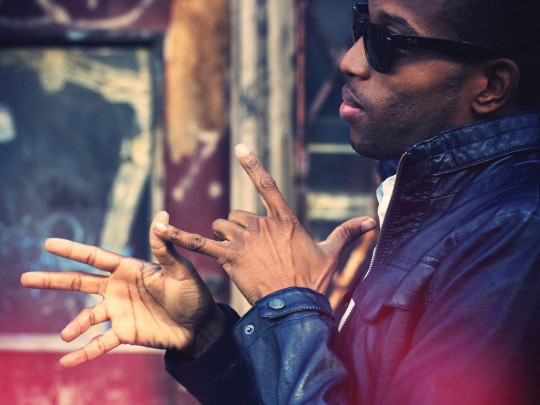
Troy ‘Trombone Shorty’ Andrews has God-given talent, natural charisma and a relentless drive to . . . bridge music’s past and future. His third outing for Verve Records, Say That To Say This (Sept. 10), co-produced by Andrews and kindred spirit Raphael Saadiq, sounds like nothing else out there, as Andrews and his longtime band, Orleans Avenue – guitarist Pete Murano, bassist Mike Ballard and drummer Joey Peebles – continue their natural musical evolution. In a very real sense, the torch is passed from one great New Orleans band to another on the new album, which features the first new studio recording from the original members of the legendary Meters in 36 years, as they revisit their 1977 classic “Be My Lady,” with Andrews singing lead and playing horns.
The bandleader and multi-instrumentalist describes Say That To Say This as “really funky, like James Brown mixed with The Meters and Neville Brothers, with what I do on top, and we have a bit of R&B from Raphael’s side. All the guys in my band are big, big fans of his, so this is a real dream come true for us. And he’s a fan of New Orleans brass band music, which I didn’t know beforehand. Just listening to his music and the direction he’s going in now, I thought that he would be perfect to work with us. What drew me to him was his knowledge of what came before and his imagination of where the music can move forward to. That’s the same way I think, so it worked out very well.”
Saadiq doesn’t just co-produce, he becomes a member of the band, playing a variety of instruments and contributing backing vocals; he also had a hand in writing three songs. Says Andrews of Saadiq: “He’s a great producer, but he’s also a musician, so he was able to get in there, jam with us and take us to some different places. And we were able to take him to some different places too.”
“We felt a certain amount of pressure, because we knew we were working with one of the great young producers and musicians,” Andrews acknowledges. “But it was good pressure, and Raphael being in the room with us inspired us to step up as writers and players. We spent an initial two or three weeks in the studio in L.A. working out the tracks, and I think having that stretch of uninterrupted time really played a big part in how creative we were able to get. On the last two records we were so busy touring that we would go in for three or four days and then go out for a week, so we had to switch on and off between the stage mentality and being creative in the studio. So this time, knowing we were gonna be in the studio for two or three weeks straight, we reached down deep and were able to do some things that we wouldn’t have come up with if we’d been on a tight schedule. It allowed us to be very free.”
Click here to read more
The first track laid down for the album, the pumping “Long Weekend,” came together in a flash during Andrews’ initial foray to L.A. to hang with Saadiq. “I went out there to see how we would jell,” Troy recalls. “I met him and his band in the studio and they came up with that song for me, right in front of my face, and it was really fun to just sit back and watch it go down. It didn’t take that long – they were killin’ it. I put the horn parts on that same day. That track has a lot of energy; I love the way it feels.”
The next step was to see how Saadiq would jell with Trombone Shorty & Orleans Avenue. “The one where we really clicked for the first time was ‘Get the Picture,'” Andrews says of this burner, which has Saadiq’s fingerprints all over it, trading guitar licks with Murano and playing clavinet. “After that, he sat back and watched us work, and every once in a while he’d come in and make a suggestion,” says Andrews of the recording sessions. “So he basically let us do what we do and fine-tuned it if it needed it, and if it didn’t he just kept it the way we had it. And that was very inspiring, because if he thought it was cool, then we felt like we’d done what we needed to do on our end.”
The opening title track emphatically sets the vibe, as Murano unleashes a barrage of power chords over a pummeling groove from Peebles and Ballard – but a blast of brass from Trombone Shorty instantly alters the feel, bringing a more elegant form of aggressiveness to the proceedings. The mood then shifts again to a deeply soulful section in the manner of Earth, Wind & Fire, before powering back into rocking mode. “That track is just a timeline of who we are and how we think,” says Andrews.
“For most of the album,” he continues, “we wanted to get it as tight as we could performing it in the studio, so we’d just play the song straight through, but we couldn’t do that with ‘Shortyville,’ which was just myself and Raphael. I started that track by hitting a bass drum with a mallet, like you would in a New Orleans brass band; then I played a full drum set on top of it. We built it up from there part by part, with me doing the horns and Raphael playing the bass and guitar.”
Of “Fire & Brimstone,” the lead single, Andrews notes, “The beat I was hearing was an old-school hip-hop thing. I can’t remember what we were listening to when we came up with the idea, it might’ve been something by Dr. Dre, Easy E or Run-D.M.C., but when I heard it, I said, ‘Joey, let’s do a beat like that underneath the track so I can do some intricate things on top.’ That’s what we did, and it came out with this swampy, voodoo feel.”
As for the impromptu Meters reunion, Andrews was listening to the band’s eighth and final album, 1977’s New Directions, one day, and as the smoothly soulful “Be My Lady” wafted out of the car speakers, it hit him that the track’s mellow, romantic vibe (“laid-back in the cut,” as he puts it) was exactly what his album in progress needed. But rather than simply covering it, Andrews got it in his head that he had to record it with The Meters themselves. When he told friends of his plan, they told him he was dreaming. Since breaking up soon after releasing New Directions, the four original members had performed together a mere handful of times, and only on stage for special occasions, never in the studio. What’s more, there was no manager to contact; Andrews had to call each one and ask if he’d be up for going in the studio with his former bandmates.
“With all four of them, when I asked the question, there was a second of silence,” Troy recounts with a laugh. “But then, each one of them said, ‘If you talk to the rest of the guys and they’re up for it, then I’ll do the track. And even if you can’t get everybody together, I would still love to play on it. So I was able to get all of them to agree, and then I had to call all of them back to tell them it was on. So they all came to the studio, including Cyril Neville, who sang the original vocal; he does the background vocal and the ad-libbing on the new track. At the end of one of the takes, they started jamming, and you could see a sparkle in all of their eyes at the magic they could make together. Whatever their differences, whatever reasons they don’t work together, it went out the window for those few minutes, and I got a chance to experience what it used to be like when The Meters made all those classic records. I had the chills while it was going on.”
“After we were done,” Andrews continues, “George Porter pulled me aside and said, ‘Thank you. You have gotten us to do something that people have been trying to get us to do for 35 years,’ and I was speechless. Because The Meters helped to create a sound that gave me a foundation for doing what I do. It was one of those magical moments in life for me, because in New Orleans, The Meters are like the Beatles.”
The title, Andrews explains, is a common New Orleans expression that essentially means “To make a long story short,” serving as a wonderfully on-point description of the album and of Trombone Shorty’s music in general. “This record is a direct expression of everything we hear, everything we’ve seen and everything we’ve been through musically,” Andrews assets. “We’re just making a long story short.”
Saadiq is equally thrilled with the results of this musical summit meeting of young giants. “If you’re a producer or musician, you want to work with other great musicians,” he says, “because it only betters you, I was just honored to be a part of the project.”
Andrews’ previous projects include 2010’s Grammy-nominated Backatown and his sophomore effort, For True (2011), which spent 12 weeks atop Billboard’s Contemporary Jazz Chart. In the past few years alone, Andrews has appeared on recent recordings by an eclectic assortment of artists ranging from Zac Brown to Eric Clapton to Rod Stewart and Cee Lo Green, while taking the time to initiate a mentoring program at Tulane University via his Trombone Shorty Foundation. He’s also been featured on the covers of Downbeat and Jazziz magazines, as well as on Conan, The Tonight Show, Jimmy Kimmel Live, Late Night With Jimmy Fallon, Austin City Limits and in a recurring role on the hit HBO series Treme. The band was also chosen to play the closing set at the 2013 New Orleans Jazz & Heritage Festival, a huge honor in the world of true music lovers.
But for Andrews, the biggest thrill of all was performing at The White House in February 2012. “That was a dream come true about 50 times over,” he says. “When we started playing, I forgot I was at the White House because I was on stage with all this musical royalty – B.B. King, Mick Jagger, Booker T. Jones, Jeff Beck, Susan Tedeschi and Derek Trucks, Gary Clark Jr., the list goes on. And then, when I turned to the audience, there’s the President and the First Lady. I’m like, ‘This can’t be happening.'”
Good things continue to happen for Trombone Shorty, thanks to his virtuosity, his dedication, and his ability to move people. That he pursues his passion with such humility and unpretentiousness makes his still-unfolding story as compelling as the music he’s making along the way.
Learn More
Joe Russo’s Almost Dead is Scott Metzger, Tommy Hamilton, Dave Dreiwitz, Marco Benevento & Joe . . . Russo.
“Not only does this quintet play tight and vicious versions of some of the most complex songs in the Grateful Dead’s repertoire, but they play them with a rawness & energy absent from the stage since the “Live” Dead era. More importantly, all of the jams are wild and incredibly adventurous. Russo’s a beast behind the kit who’s in the peak of his career. Metzger is a criminally underrated guitarist who has a chameleon-like ability to alter his sound to compliment any situation. Dreiwitz’s intensity is unmatched by anyone, while Benevento spouts these crazy tones and layers of sound that mix the best of what each keyboardist in GD history brought to the band. Finally, add Hamilton, whose voice and biting leads help push this ensemble over the top.” – Scott Bernstein, Jambase 9.12.13
Learn More
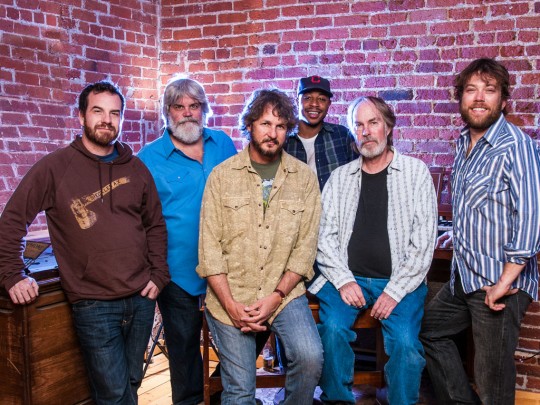
Looking back over the past 25 years of rootsy, string-based music, the impact of Leftover Salmon is . . . impossible to deny. Formed in Boulder at the end of 1989, the Colorado slamgrass pioneers were one of the first bluegrass bands to add drums and tour rock & roll bars, helping Salmon become a pillar of the jam band scene and unwitting architects of the jam grass genre.
Though the lineup would change through the years, the foundation of Leftover Salmon was built on the relationship between co-founders Drew Emmitt (vocals, guitar, fiddle, mandolin), Vince Herman (vocals, guitar,washboard) and Mark Vann (electric banjo). Following a decade of constant growth and constant touring, on March 4, 2002, Mark Vann lost his battle with cancer. Vann insisted that the band carry on and Salmon did so for several years leading up to an indefinite hiatus in 2005.
If Leftover Salmon had never played another note after leaving the stage in 2005, the legacy would have been secure; the members’ names etched in the books of history. But today, more than two decades after Salmon first took shape, the band has a new album, Aquatic Hitchhiker, due May 22 on LoS Records, a new banjo phenom named Andy Thorn, and a new lease on an old agreement. Leftover Salmon is officially back.
[learn_more caption=”Click here to read more”]
The 29-year-old Thorn grew up a Salmon fan in North Carolina and says the band helped him realize “this is what I want to do with my life.” Ironically, it’s his presence in the group that has given Leftover Salmon new life. “Andy’s a real young guy with a lot of great energy who plays in a way that definitely relates to Mark’s [Vann] playing and he’s a lot of fun to be around, it’s led to a real revival that just clicks on some hard to describe level” says Herman. “We’ve played with some great banjo players over the past few years, and not to say anything about them being less than great musicians, but there’s just something intangible about playing with Andy that kind of makes Drew and I look at each other and grin. This is what we’ve been missing as far as that feeling between Drew, Mark and I that used to be there.”
Produced by Los Lobos’ Steve Berlin, Aquatic Hitchhiker is Leftover Salmon’s first record in eight years and first ever of all original material. “Steve [Berlin] understood where this album needed to go and how we all needed to work together as a band to make it happen” explains Emmitt. Set for release on May 22, the recording process solidified the new Salmon, cauterizing old wounds and allowing fresh ideas to grow over past scars.
“The time is right for this band to come back on a lot of levels” says Emmitt. “It’s taken us a little while, but I think we’re finally there.”
[/learn_more]
Learn More
Keller’s Grateful Grass delivers anything-but-traditional bluegrass versions of Grateful Dead . . . favorites. The project’s lineup is always rotating, and Vibes is no exception. Jeff Austin (Yonder Mountain String Band) and Reed Mathis (Tea Leaf Green) join Keller this summer on the Grateful Grass at Seaside Park.
Keller Williams has been called guitars mad-scientist, a one-man-band for the new millennium and dozens of other clever sobriquets dreamed up by fans and music journalists trying to get a handle on his uplifting and ever-shifting style of music. Williams is considered by some but not by himself, to be a master of the acoustic guitar, known for his ability to solo over layers of spontaneously created loops. He is a generous performer who plays down to earth acoustic music that defies any effort to find a convenient pigeonhole. If pressed for a definition, Williams, as adept with language as he is with a guitar pick, calls it solo, acoustic jazzfunk reggae technograss – or simply – solo acoustic dance music.
Click here to learn more
On stage, Williams exudes a restless yet mellow energy. Barefoot he dances in place, alternately spinning out long solo lines and bouncing chord clusters that draw listeners and dancers into his own private world of rhythm and melody. The songs flow like rivers, full of flickering, kaleidoscopic images revealing new shapes, colors and meanings with every listen. On the stage behind him is a forest of stringed instruments as well as a keyboard and various drums and percussion toys. Williams jumps between instruments seeking out the perfect sound, the perfect note, the perfect beat that will transport him and his audience.
Much has been made of Williams impressive array of stage gear. Hes willing to go on at length about each instrument and the complexities of creating loops and samples in real time, with nothing being pre-recorded. But isnt into technology for its own sake. Williams explains, My style evolved organically out of hours and hours of being on stage with one guitar and one mic. I wanted to create more of a dance vibe and make it more interesting for myself, and hopefully more interesting for the audience, too.
Williams is also a prolific recording artist, with ten albums and a DVD in his discography each of which carry one word titles. The latest CD in Williams growing catalogue is GRASS – credited to Keller & the Keels. The self-released album is a delightfully bizarre collection of anything-but-traditional bluegrass songs. Like most recordings from Keller, GRASS is self indulgent and possibly offensive to those who lack a sense of humor, but Keller had a damn good time recording it. For the project, Keller teamed up with old buddy and award-winning flat picker Larry Keel on guitar, and Larrys beautiful rock-solid in-the-pocket acoustic bass playing wife, Jenny Keel. The result is an organic and airy acoustic record featuring 10 songs, originals and unexpected covers tunes, that yield to a pure love of music. Williams farcical humor and the stellar picking of the ensemble is evident on the albums original tunes. Goofballs is a late night driving song, Williams says. You’re trying to stay awake to avoid a wreck and start thinking the weirdest things to stay alert. Local (Outdoor Organic) is a ballad about supporting local organic farmers. Crater in the Backyard showcases the trios instrumental prowess and talks about the wide-open spaces that get turned into strip malls and subdivisions.
Williams was born and raised in Fredericksburg, Virginia. My mom and dad sang in church and my mom played some piano, but their main instrument was the stereo, Williams quipped. I had a guitar at age three, but didnt learn any chords until I was 13, when a friend showed me three primary chords. I started copying songs off of classic rock radio. A few years later I started performing. Williams played in cover bands in high school and college, but he was also playing solo in non-music venues. I hit up restaurant owners and played while people were eating. The people weren’t there for music, so between songs there would be awkward silences. I started stringing songs together, so there wouldnt be any silence. William’s college band got good enough to build a regional following and open for national acts that came through town. When the band broke up, Williams went back to his day, or late afternoon – early evening job, of playing in restaurants. In 1995 Williams moved to Steamboat Springs, Colorado for two years, then from 1997 to 2000 he had no address at all, living in campgrounds, truck stops and cheap ass motel rooms, playing constantly, sometime seven gigs a week, and barely making ends meet. But it honed his guitar playing and stage show to a fine edge.
“I saw The String Cheese Incident on my first stop in Colorado. They were playing a basement bar after the Telluride Bluegrass Festival in 1995. They were bouncing from reggae, to bluegrass, to rock, to salsa. I approached them as a fan and told them Id be happy to open for them for free. They took me up on that offer and I jumped onto their West Coast tour in spring of 1997. They were just starting to build their grassroots following, and I had so much fun opening and then going into the audience and dancing. Williams was already experimenting with looping, using a delay unit to so he could play along with himself. Then he opened a few shows for Victor Wooten, who had made an art out of creating loops on stage. Victor opened my ears and eyes to how you can use live phrase sampling (looping) on stage. Once I saw what he was doing, I incorporated it into my style and came up with my own recipes. As more young people started coming to my shows, I added bass guitar and realized I could fill up a venue with the whole spectrum of sound. The loops push me musically and open up different avenues for me to go down. My songs are deeply rooted in guitar and vocals. Looping is used to create a jam section, though there are some exceptions, where I set up a loop and sing over the top of it.”
Williams started recording albums in 1993 and cut three albums on his own dime FREEK, BUZZ and SPUN – before signing up with SCI Fidelity Records. Since he started recording, Williams has turned out almost one album a year, including three of his most successful releases: LAUGH (2002), HOME (2003) and his double live release STAGE (2004). I like one word titles because they sum up the process with the least amount of syllables.
Williams is currently finishing work on his next studio project YOUTH. “I’ve been at it for two and a half years and hope to have it out in fall of 2006. Its a collaborative process. I’ve flown all over the country to do sessions with my heroes and there are still more tracks to be done with more heroes at press time. To name drop a few: Bob Weir, Victor Wooten, Charlie Hunter, Derrek Phillips, Steve Kimock, John Molo, Martin Sexton, The String Cheese Incident, Sanjay Mishra and Fareed Haque to name just a few.”
Learn More
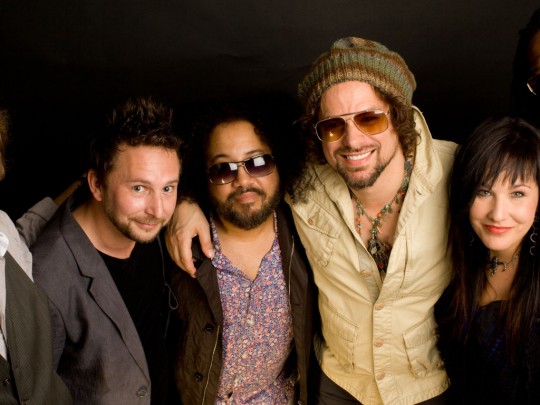
Multi-instrumentalist group Rusted Root integrate the Grateful Dead’s jam-heavy rock with percussion . . . influences based on the music of Africa, the Middle East, and Latin America. The six-piece formed in Pittsburgh in 1990 with Michael Glabicki (vocals, guitar), Liz Berlin (vocals, percussion), Patrick Norman (bass, vocals), and Jim Donovan (drums, percussion) as the initial lineup, though John Buynak (percussion, winds) and Jim DiSpirito (percussion) joined later that year. In 1992, Rusted Root released its debut independent album Cruel Sun. However, it was the band’s 1994 sophomore album, When I Woke, that garnered the band national attention.
Having collaborated with one another for two decades, Rusted Root, has honed the perfect combination of musical intuition, freedom and virtuosity, which has allowed them to organically shape shift their music into their own distinct and undeniable vision. With eight albums under their belt, over three million records sold worldwide and countless nights on the road, Rusted Root, transcends age, generations, cultures and musical styles.
The powerhouse ensemble’s sweat-inducing and hypnotic live performances have allowed them to tour alongside everyone from Santana, Dave Matthews Band, The Allman Brothers Band, Robert Plant and Jimmy Page’s reunion tour and countless others. Rusted Root’s Shanachie debut, The Movement (10/30/12), is an energized and poetic collection of originals that capture the Pittsburgh based unit at their best.
Learn More
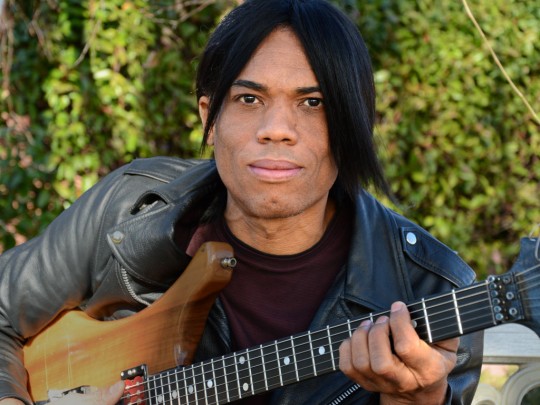
In a career that took flight in 1985 with immediate commercial and critical acclaim, guitar virtuoso . . . Stanley Jordan has consistently displayed a chameleonic musical persona of openness, imagination, versatility, respect and maverick daring. Be it bold reinventions of classical masterpieces or soulful explorations through pop-rock hits, to blazing straight ahead jazz forays and ultramodern improvisational works, solo or with a group, Jordan can always be counted on to take listeners on breathless journeys into the unexpected.
On his latest Mack Avenue recording, Friends, Jordan takes the time-honored path of inviting a handpicked cadre of guests: guitarists Bucky Pizzarelli, Mike Stern, Russell Malone and Charlie Hunter; violinist Regina Carter; saxophonists Kenny Garrett and Ronnie Laws; trumpeter Nicholas Payton; bassists Christian McBride and Charnett Moffett; and drummer Kenwood Dennard. The results proved truly outstanding on numbers ranging from a Bela Bartok piece to a Katy Perry pop smash, a heady original blues and three jazz classics spanning swing, cool and modern. There’s a listener-friendly samba, an airy spirit song and an astounding nod to the atonal. Jordan even plays some serious piano on a couple of songs, revisiting his first instrument with newfound confidence and wonder.
Jordan opens Friends with the straight-ahead original Capital J featuring Kenny Garrett on tenor saxophone and Nicholas Payton on trumpet. “So much of the great jazz I grew up with was built on a strong horn line,” Jordan states. “In the spirit of those great classics I wrote this tune. Nick’s tone is fresh and full of life, and he creates interesting, complex improvisations while still leaving plenty of space. Kenny combines a deep musical knowledge with a natural and effortless facility. My favorite part of Capital J was just comping behind the horns.”
Click here to read more
A trip to Bluesville is next with Walkin’ the Dog, which recalls B.B. King but with some edgier things going on around the fringe. Jordan collaborates with groove-master Charlie Hunter on this one. “Our paths have crossed in many jam band situations. We both play multiple parts at once, but he plays more in the lower range while I play more in the higher range, so we complement each other very well.”
Next up is the big band standard Lil’ Darlin’, a gem from the pen of the great Neal Hefti redefined as a quintessential ballad by Count Basie. Together Jordan and guitarist Bucky Pizzarelli create a dreamy romantic feel. “Bucky brought that one in and gave us all a history lesson. How precious this moment was, reminding us that we were in the presence of one of the greats who helped create this music we call jazz.”
Jazz rocker Mike Stern emerges next for a mind-blowing spin through the groundbreaking John Coltrane classic Giant Steps. “Mike and I cut our teeth in the same scene in New York in the early ï80s. Once we jammed together on Giant Steps back in the ’90s while on tour. He glides through this complex tune with an approach that is so beautiful, natural and musical.”
Jordan really lets the fur fly with his take on pop sensation Katy Perry’s runaway hit I Kissed a Girl on which he plays guitar and piano simultaneously in a second teaming with Charlie Hunter. Jordan, who scored massive hits with covers of Michael Jackson’s The Lady in My Life and The Beatles’ Eleanor Rigby, sees this as a vital continuum in both jazz history and his history. “I chose a song from the current generation, a generation moving into a more tolerant and accepting world.”
Samba Delight, featuring Ronnie Laws on soprano saxophone and Regina Carter on violin, puts one in the mind of tropical paradise. “Ronnie is a remarkable and versatile musician who is at the crossroads of many musical worlds,” Jordan explains. “When I showed Ronnie Samba Delight he remarked on how much he liked the tune. It felt really good to hear that because I composed it with him in mind!”
The pendulum swings back to jazz with the super standard Seven Come Eleven, a song made famous in Benny Goodman’s band as a feature for electric jazz guitar pioneer Charlie Christian. In loving homage, Jordan put himself together with Bucky Pizzarelli and Russell Malone to swing this classic into the rafters. “When I told Bucky I was thinking about doing Seven Come Eleven he just lit up! I love the old time three-way improv we played toward the end. Bucky played a rousing solo and Russell was great as well, providing a cool yet uplifting spirit.”
Learn More
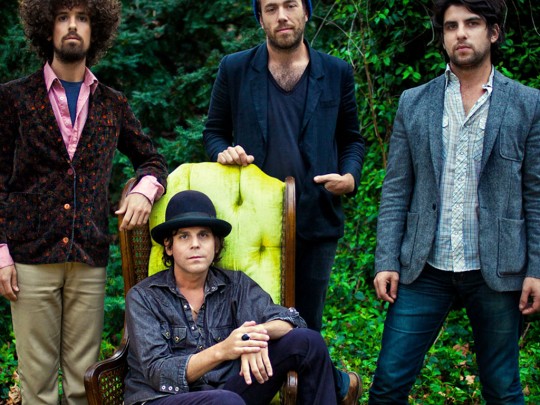
There is nothing like the challenges and camaraderie of the road to inspire a songwriter who thrives . . . upon the emotional energy and exhilaration only travel can deliver. Some singers are devoted to the pursuit of perpetual motion, and Langhorne Slim releases his wild soul in ways that come out of the discipline of live performance.
The 13 songs that compose Langhorne Slim & The Law’s new The Way We Move are road-tested, rollicking and very rock ïn’ rolling tunes that the songwriter perfected with his loyal band, and come out of the kind of good times and bad experiences that songwriters of Langhorne’s lofty stature can turn into life-affirming rock ïn’ roll. You could also call what Langhorne Slim does folk music, but then there’s his sly, charming and open-hearted feel for pop music, those summertime melodies that nudge you into a grin even when the song is about something bad.
For Langhorne Slim, Pennsylvania-born self-taught guitarist who moves to Brooklyn at 18, begins feeling out his place in a burgeoning punk-folk scene, wends his way to the West Coast, and finds himself celebrated from Newport to Portland as one of today’s most original singers and songwriters, The Way We Move represents the sound of a band devoted to living in the moment. Riding the success of his 2009 full-length Be Set Free, Langhorne went through some changes over the last three years, he lost his beloved grandfather, who is the subject of the new record’s moving “Song for Sid,” and moved on from a relationship that had lasted five years.
And there was the physical moving, the literal side of the record’s title. Pulling up stakes from his home of two years, Portland, Ore., Langhorne also has been touring non-stop with The Law. As he says, “I’m in a bit of a transitional period, currently, the road will be home. That’s just kind of my spirit, to be slightly restless.” Perfecting their rangy sound out on the endless grey ribbon, Langhorne and The Law, bassist Jeff Ratner, drummer Malachi DeLorenzo and banjo player and keyboardist David Moore, went down to rural Texas in the summer of 2011 to work on new material. With some 30 tunes to consider, the quartet soaked up the Lone Star sunshine and developed arrangements and approaches for Langhorne’s latest batch of songs.
Click here to read more
Jeff Ratner had joined the group at the time of Be Set Free, and brought on multi-instrumentalist David Moore not long after. Moore and Ratner go way back, having moved to New York around the same time, and they’ve played together in what Jeff estimates are 15 bands. Langhorne’s association with Malachi is equally deep. As the group played together through tours with the Drive-By Truckers and the Avett Brothers, and made appearances at the Newport Folk Festival and Bonnaroo, their bond became ever stronger, their music more confident. This is what you hear on The Way We Move, forward motion meeting deep cohesion, all in the service of Langhorne’s amazing songs and compelling vocals.
“We wanted Langhorne’s songs to shine, and be as raw as the creatures that we are,” Jeff says of the recording process. The band set up in the Catskill, N.Y. Old Soul Studio, a 100-year-old Greek Revival house retooled for recording. With studio owner Kenny Siegal co-producing, Langhorne & The Law fearlessly ran through an astounding 26 songs in four days, with Langhorne putting finishing touches on new tunes as they recorded. Langhorne says it was an intimate affair in Old Soul, with Moore’s “banjo room” in a coatroom and the piano in the living room.
It comes through on The Way We Move, the live feel of the sessions, which found Langhorne singing along with the band on every track. “Singing with the band that way, it’s almost like I was performing on stage,” he says. Cutting everything live to tape gave the band exactly what they’d been looking for: a super-charged evocation of their raucous, friendly stage performances. Langhorne and Jeff value in music for its rawness, and it doesn’t matter whether that rawness, the insurgent spirit that unites the Clash and Charlie Poole, comes from in punk, country, soul or folk. Langhorne is a fan of Porter Wagoner, Jimmie Rodgers, Waylon Jennings, and early rock ïn’ roll in general. But there’s nothing referential or detached about the music Langhorne & The Law make. Langhorne writes songs that are yearning, sad, happy, defeated and optimistic, with hints of ï50s rock ïn’ roll balladry.
“We all love Wu-Tang Clan as much as we love Bowie, or Brazilian psychedelic pop,” Langhorne says. On The Way We Move, David’s probing piano often provides focus for Langhorne’s tales of love and loss. “On the Attack” begins with a delicate, watercolor section that turns into an ingenious variation on a classic soul ballad, Solomon Burke meets punk blues in a smoky folk club. Langhorne addresses it to a current or past love. Similarly, “Past Lives” sports a piano introduction that gives way to a melancholy 6/8 ballad that perfectly supports lyrics about possible past lives and their interaction with the present.
It’s a spirited, inspired slice of real rock n’ roll, exuberance meets hard-won experience in an explosive combination. David’s banjo and Malachi’s walloping drums add up to a new kind of folk music. The music drives, but there’s no loss of subtlety. And when the group lays into the garage-rocking “Fire,” with its funky electric piano and supremely callow lyrics about first kisses and the hot-burning passions of adolescence, it’s clear Langhorne is one of the great rock ïn’ rollers of our or any time.
Road-tested as the band is, the new music also shows just how far Langhorne Slim has come as a singer. He croons, exults and sings the blues throughout The Way We Move. And there are his lyrics, which are about strange dreams featuring women who want him dead even as he desires them, the pressures of small-town life, ambition, and how much he appreciates his mother’s love and support. That’s all Langhorne and his life, his mother, he says, really was amazingly supportive of his ambitions to become a musician, as was the rest of his family.
It comes through as you listen to his virtuoso demonstration of a singing style that seems alive to every fleeting emotional shade of meaning. Langhorne puts you in mind of John Lennon’s singing from time to time, it’s nothing exact, and Slim doesn’t do much music that is very Lennon- or Beatle-esque, but it’s something in the timbre, and the openness of his vocals. It’s worth repeating here that Langhorne learned Nirvana songs as he began to explore the guitar and songwriting, and Kurt Cobain’s intense singing is another reference point.
But these guys don’t play the reference game, and like to keep it raw. The new record moves in ways that are fresh for Langhorne Slim & The Law, and demonstrates all the ways we can go forward while keeping an eye on the mirror. They’re laying down the law. It’s very American, and when Langhorne Slim contemplates whether or not he fits in to any narrow-cast definition of this country’s music, he replies with a perfect, laconic joke: “I think we fit in most places that would take us.”
Learn More
Dopapod isn’t so much a jam band as they are a band that improvises. They are an electronic band . . . without computers. They are a metal band with groove and soul. They are a jazz group with less wine and more acid. They are what would happen if Zappa, Yes, Deadmau5, and The Meters all sat down for a cup of coffee.” – RVA mag
With no regard towards towards stylistic boundaries, the sound that emerges from Dopapod both live and in the studio is as varied and diverse as the many influences that they adapt from. Their approach and commitment to complementing a distinct genre bending sound to top-notch musicianship has set them apart from many of their contemporaries and keeps music lovers eagerly returning to shows.
Dopapod has been touring nationally playing 150+ shows a year for the last four years. Their rigorous tour schedule has seen the young, yet seasoned group make appearances at numerous festivals including Rootwire, Gathering of the Vibes, Bonnaroo, Summer Camp, Electric Forest, Burning Man, Bear Creek, PeachFest, Camp Bisco, and more. The band’s electric live showcase has been cultivating a fast growing and loyal fan base.
Their third studio effort ‘Redivider’ was release on December 21st 2012. Having been recorded and released less than a year after the band’s last record Drawn Onward came out, recording was done at Tyrone Farm, a scenic and completely solar powered farm in the small town of Pomfret, CT. Opting to take a different route than recording in a studio, the band brought their own to the barn of the farm and produced it by themselves. ‘Redivider’ displays a drastic evolution in the band’s songwriting skills as well as marking the first time ever that the band has added vocals into songs. The added texture serves as yet another dimension in what allows the band to look in multiple directions at one time while remaining focused on a cohesive blend of sound.
Learn More
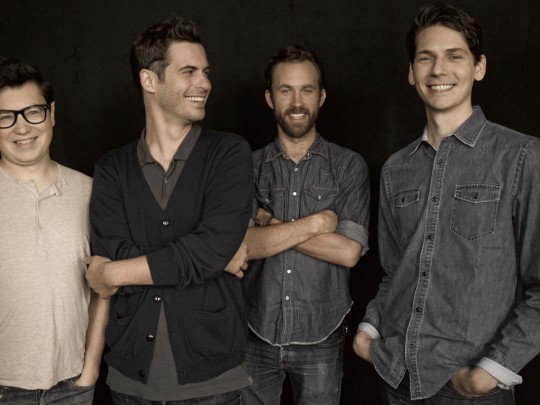
“It has taken five records to make one that sounds the way we do onstage,” says White Denim frontman . . . James Petralli, explaining the band’s new full-length “Corsicana Lemonade.”
Set for release October 2013 via Downtown Records, “Corsicana Lemonade” puts White Denim’s freewheeling stage ethos to wax and cements their position as a quintessential, unique American rock band. Featuring production on two songs and a full mix from iconic songwriter Jeff Tweedy, it’s a revelation, merging the group’s manic live virtuosity into a rollicking ten-song mission statement.
The Austin, TX four-piece is no stranger to mixing crunchy punk energy, scorched psychedelia, Southern rock and knotty funk, but “Corsicana Lemonade,” the group’s fifth studio album, naturally covers so many bases that it plays like the greatest lost mixtape you could find on your dashboard during a hot summer afternoon.
Since its formation in 2005 and first string of EPs in 2007, White Denim has steadily expanded its sound. From the rootsy classicism of “Last Day Of Summer” (2010) and noisy sun-soaked sizzle of “Fits” (2009) to the soft-edged riffage of “D” (2011), the group’s commitment to fiery live performance, textured exploration and blissful interludes has never wavered. It peaks on “Corsicana Lemonade.”
Album sessions started in Chicago at fabled Wilco compound The Loft with Jeff Tweedy (and frequent production partner Tom Schick) manning the boards and providing motivation. The record was almost entirely recorded live with full-band takes, ensuring a lived-in live feel.
“Before, we had kind of leaned on the ability to give the impression of a full live band on our recordings. That Protools Rock is way more common than people know,” says Petralli. “On ‘Corsicana Lemonade,’ it was actually the band playing together and doing takes as a whole. Whatever sounded best was what we stuck with.”
Click here to learn more
After the Chicago sessions, White Denim returned to their native Austin, holing-up in a house overlooking Lake Travis from a 100-foot cliff. There, with the help of local producer Jim Vollentine, the band designed a makeshift studio, wheeled in a bunch of crazy ’50s gear and solidified the mixture of hard and classic rock elements that they began exploring on their fourth album “D.”
The record’s songs feel at home with the skuzzy rawness of contemporaries like The Black Keys or Jack White and the Americana experimentalism of Wilco, while the band cites the classic rock shuffles of Thin Lizzy and The Allman Brothers’ instrumental ecstasy as primary influences.
And now, with the support of leading publications like the New York Times, Rolling Stone, Pitchfork and Relix, as well as adoring crowds from Bonnaroo to their sold-out headlining tours, White Denim has fully arrived with a record to claim their own spot in America’s great rock lineage.
“Corsicana Lemonade” is available in October 29, 2013 via Downtown Records. Catch the band at Austin City Limits this October and on tour with Tame Impala this fall.
Fun Fact: White Denim likes to maliciously throw things at cameramen.
Learn More
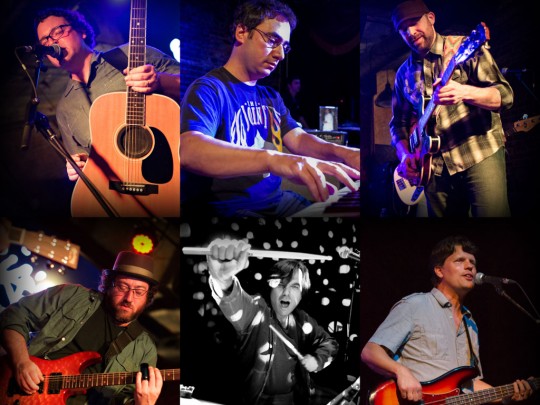
Assembly of Dust and God Street Wine are two bands that are Vibes Veterans, and both never fail to . . . deliver surprising, exciting sets of music. As a special treat for this year’s Vibes, key members of both bands are going to join forces as “Assembly of Wine,” a unique configuration that promises to combine the magic of both AOD and GSW in an explosive, high-energy mix of festival favorites and brand new covers. Assembly of Wine features Reid Genauer, Adam Terrell, and Dave Diamond from Assembly of Dust, and God Street Wine’s Aaron Maxwell, Jon Bevo and Dan Pifer. Don’t miss ’em!
Here’s what the band had to say:
Yep, you read that right! We had a chance to jam with the God Street Wine guys several times over the past year and all of us enjoyed the hell out of it. As such, we came up with the notion of “Assembly of Wine.”
Here’s the Deal:
Reid, Adam and Dave will represent AOD while Aaron Maxwell, Jon Bevo and Dan Pifer will be the GSW members. Rock fans of all ages can expect a mix of both bands’ songs, some bumping covers.
Learn More
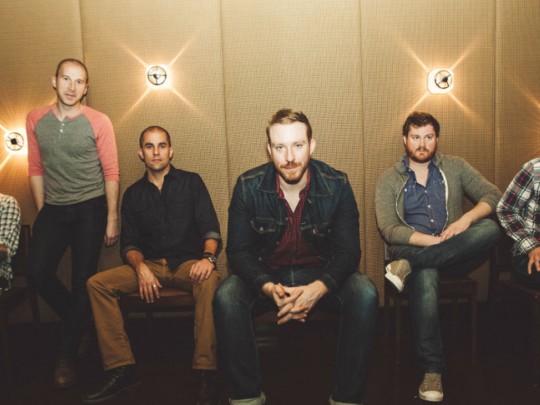
Bronze Radio Return know what it takes to get to the heart of American roots music. You have to go . . . to America’s roots.
When it came time for the band to record their latest full-length album Up, On & Over, they found themselves in the foothills of the Appalachian Mountains on a farm in the tiny town of Louisa, Virginia. In their journey as a band, recording in different parts of the United States has opened up their ears and minds. “We find it’s easier to get into a creative zone when we’re outside of our element,” lead singer and guitarist Chris Henderson explains, “we were surrounded by goats, chickens, and farmland.” The trek south this year was just the latest venture for Bronze Radio Return (Henderson, drummer Rob Griffith, lead guitarist Patrick Fetkowitz, keys player Matthew Warner, bassist Bob Tannen, and harmonica/banjoist extraordinaire Craig Struble) who are no strangers to recording in new, and sometimes remote, places.
Their story starts in Hartford, where members orbited each other at The Hartt School, one of the country’s top music conservatories. After finding each other and solidifying their line-up in 2008, they began writing music and found that their surroundings played a huge part in their creative energies. While writing their debut album Old Time Speaker, they bounced between the buzzing urban community in Hartford, where Henderson says melodies and chord progressions come naturally, and a remote Maine town, where they holed up to focus on lyrics. When they went into the studio in 2009, they went, as Henderson says, to “a place we’d never been before with a producer we’d never met to play a bunch of songs we’d never played before.” The producer was Chad Copelin (Ivan & Alyosha, Ben Rector), who would go on to form a solid and lasting partnership with the band.
[learn_more caption=”Click here to learn more”]
Two years later, Copelin brought the band to his home turf in Norman, Oklahoma to record their follow-up album Shake! Shake! Shake! The small community lived and breathed music. The Midwestern neighborliness and kindness shined through on the album, drenched in harmony, warmth, and soul, the songs were made to make people come together. Sing-alongs, foot stomps, hand claps, and all.
It was during this time that the band began to get picked up for numerous TV spots and ads. Shake! Shake! Shake! produced over 50 syncs in the past year-and-a-half when all was tolled. Highlights include a worldwide Nissan Leaf commercial and a national Behr Paint/Home Depot ad. In addition, HBO, ESPN, NBC, MTV, the CW, American Idol, ABC Family, USA, and more licensed their music for shows, promos and bumpers. Instead of waiting for the syncs to break them out, Bronze Radio Return threw themselves into a rigorous touring schedule. “We’ve been really fortunate to have our music used in a lot of TV and film, and also made some real traction at radio. But this band is first and foremost a live band,” says Henderson. The band has spent the better part of the last two years playing every corner of the US and winning fans over with their packed-with-energy live show.
Cut back to 2013 and find Bronze Radio Return back in Virginia with Copelin at their side recording Up, On & Over, the band’s most ambitious release to date. “You can hear there’s an obvious progression with this batch of songs. It’s very much still a Bronze Radio Return record but we really found ourselves getting into a groove during the recording process which allowed us as a band to dig deeper into the material than ever before,” says Warner.
The album is a collection of songs defined by the band’s ability to step out of their comfort zone and push forward. Leading the way is first single “Further On,” an optimistic anthem steeped in summertime brightness. “Further On” started making waves months before the album’s anticipated release, when it was tapped as the soundtrack to the PGA Tour’s national ad campaign featuring Tiger Woods and Phil Mickelson. The rest of the record follows suit with strong hooks, twangy guitars, and driving percussion. While we can’t be sure where Bronze Radio Return’s story will take them next, Up, On & Over is an exciting new chapter in their journey. Keep an eye out as their story unfolds, taking us all for a ride moving… well, Further On.[/learn_more]
Learn More
“I hope my songs evoke the same laissez-faire I grew up witnessing and am always jonesing to be . . . around. My lyrics are simply a diary telling the story of my history; boating in Lake Maurepas in the pouring rain, listening to George Jones and eating chili beans in muddy clothes, hearing Robicheaux sing the blues from the sidewalk, gutter-punks busking anti-war folk standards on Royal, Baptist gospel healings, the erotic passions of Bourbon Street and Storyville, hearing that riverboat calliope up and down the Mississippi all day long like a wind chime in the breeze”
Crash’s story unfolds with that particularly Southern swagger and wit, a tale of a Louisiana boy bred on Waffle House breakfasts and monster truck rallies, local rodeos and the flicker of family bonfires. As a youth he pulled slingshots and shot bb’s at the Popcorn trees, swam, fished and stomped his feet to the tune of his own Pawpaw’s country band.
As adolescence crept in, crash found he had an itch for singing, passing through the French Quarter to learn at the feet of the New Orleans’ legendary street performers, a young man searching for inspiration among the sodden Voodoo alleys of America’s most soulful city. Later, he would steal his Mom’s car to play the open mic nights at The Neutral Ground Coffeehouse, or to sneak into Nick’s on Tulane, or shoot pool at Dixie Tavern. He started a folk act, a punk group and finally, just after high school, started singing on the regular and was appointed “Congregational Song Leader” in a Southern Louisiana Gospel Choir, which had him performing for hundreds at a time.
[learn_more caption=”Click here to read more”]There was college for a hot minute, there was a move to the Irish Channel, there was the soaking in of all that is New Orleans, wet heat and Sazeracs, the wailing horns of jazz funerals, the teetering handmade floats of Mardi Gras, crawfish and etouffee and howling at the moon. There was work where he could get it, toiling as a PA on the studio sets, Hollywood coming south for the tax credits.
It was on these film productions where crash earned his nickname, something to do with a questionable work ethic and repetitive tardiness (he admits you’d have to ask one Ms. Rita Wilson for the real deal details). And yet despite his reputation (or perhaps because of it), he was anointed “assistant” to Johnny Knoxville during The Dukes of Hazzard’s run. (One can only imagineƒ)
Then, the rains came, Katrina bearing down hard and fast and the New Orleans that he once knew vanishing forever under poisoned water. Lost, crash reached out to his pal Knoxville, who responded with an offer of help – a job, a place to lay his head, an invite to head west, to Cali. And so he packed his guitar and went, straight into the heart of Tinseltown, to the sweet promise of a Golden State.
crash brought his music with him, quickly joining the critically adored local act Deadly Syndrome as lead singer and frontman, bringing his gris gris into the beautiful belly of the L.A. beast. Since then, crash has been barreling ahead, recording prolifically with Deadly Syndrome, working with famed producer Daniel Lanios, composing a live stage score, acting in a few national commercials, and finally, after Deadly disbanded in 2013, heading out on the road with his pals, Edward Sharpe and The Magnetic Zeros, as percussionist and angelic vocal accompaniment.
And somewhere in that heady mixƒin that combination of the rolling road, of California eucalyptus sway and dark NOLA mysteries, he discovered his true self, the wild-eyed, sly-tongued, strutting, winking and wonderful crash’ of this here solo debut. Produced and engineered by the multitalented Ed Sharpe lead guitarist, Mark Noseworthy, (and featuring friends from the Zeros, Dawes, The Mystic Valley Band and moreƒ) Hardly Criminal is the culmination of all that is strange and sad, hilarious and harmonious, about crash’s own true tale. It is story – moving, funny, weird, and stunningly beautiful.
You can hear the South, yes, Neville swing and Dr. John ju-ju, but you can also hear smooth soul, booty funk, and ragged folk, a mix of sounds taken from his past and pushed into the future, all accompanied by a deadpan storytelling prowess and a voice like a Cajun Prince (as in “The Artist Formerly Known As”). Hardly Criminal is the sum of crash’s best parts, the sonic celebration of his story so far. So, set down a spell, cool yer bones, cher… and listen.[/learn_more]
Learn More
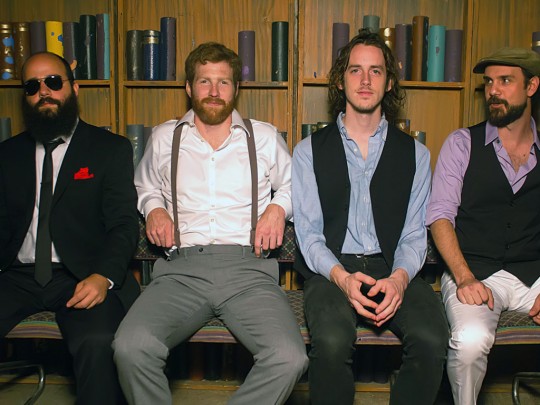
Since 2007, American Babies has been the mouthpiece for Philadelphia based musician Tom Hamilton. . . . After spending the early 2000s building a national fan base fronting the electro-rock band Brothers Past, releasing two critically acclaimed albums, and averaging 150 shows a year, a change was in order. cMusically, I wanted to get back to the basics” he explains, “Get the song right, first. Then worry about the live show and how the music opens up from there.”
Hamilton went back to his roots, rediscovering the Outlaw Country, Motown, and Grateful Dead records he grew up with, and assembled a pool of musicians to pull from for recording sessions and live performances. After two full-length LPs, an EP, and three years of touring, the American Babies are hitting their stride. The live band has been solidified with David Butler (Lee “Scratch” Perry) on drums, Adam Flicker (The Brakes) on keys, and Marc Friedman (The Slip) on bass. The band has shared the bill with numerous like minded acts such as Derek Trucks, Sheryl Crow, Umphrey’s McGee, Railroad Earth, and The National to name a few.
Hamilton entered a Philadelphia studio in January of 2013 to start work on what has become the Babies’ third long-player “Knives and Teeth” (via The Royal Potato Family). When asked to describe his new record, his answer is short and compact but, like his lyrics, is loaded with deeper meaning: “It’s a 40-minute existential meltdown.”
“When you’re in your 20’s,” he says, “you worry or focus on things that don’t seem to maintain their importance as you get older. Chicks, partying, finding a place. Shit, all of my albums back then were about girls, in one way or another. Then you grow up and you realize none of it actually matters, so you dig deeper. I spent a lot of time with some activist friends and the Occupy movement. That pushed some buttons but, I kept digging. Then I had a couple of close friends pass away within a few months of each other and that made me really dig in. I started to think about my own mortality. Reconsidering what was really important to me.”
Throughout the course of the album, from the Lou Reed-inspired “This Thing Ain’t Going Nowheres” to the inspired punk energy of “Bullseye Blues” to the head-shaking acceptance of “Goddamn,” Knives & Teeth speaks of fragility, cruelty, frustration, and the search for what makes a life worth living.
Be sure and catch American Babies’ re-energized live show on the road throughout 2014!
Learn More
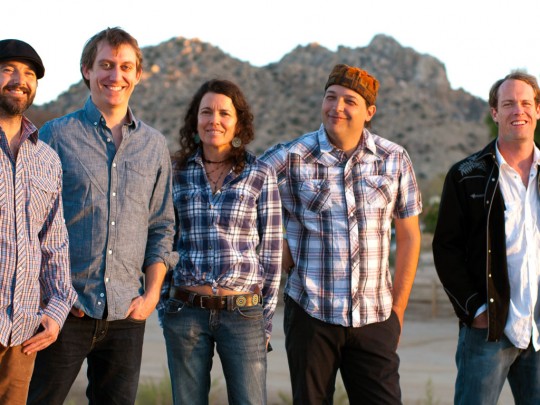
Look around you. Consider the keepsakes you cherish, the relationships you relish, the enduring . . . cornerstones in your life, and ask yourself how many have held steadfast since 1989. Closing in on the quarter-century mark, Donna the Buffalo has proven itself a consistent purveyor of Americana music. What’s the recipe? To be sure, it’s infused with more spices than you’ll find at a Cajun cookout by way of a southern-fried, country bluegrass jamboree.
Over the years, the band has also built a following that proudly calls itself The Herd, along with a well-deserved reputation for crafting social narratives and slipstream grooves without equal. To merely call this “roots music” does it disservice, for the roots nurtured by songwriter-vocalists Jeb Puryear and Tara Nevins run wild, deep and strong, a tribute to how much Donna the Buffalo marries musical trailblazing and tradition. What other group can tackle reggae, zydeco and jam-band stylings with such abandon?
Yet even the most robust roots get tested by the seasons. And as work began on a new Sugar Hill Records release, Tonight, Tomorrow and Yesterday, Donna the Buffalo took an astounding leap of faith where other veteran groups would gladly phone it in.
Puryear and Nevins, joined by band members David McCracken (Hammond organ, Honer Clavinet & piano), Kyle Spark (bass) and Mark Raudabaugh (drums), convened in a rustic church in Enfield, New York. The building lacked running water, but overflowed with vibe enough to serve as a makeshift studio. Likewise the music poured out as the group recorded take after live take to old-school analog tape, with as few overdubs as possible. What’s more, they worked without an outside producer, and suspended work on Sundays for obvious reasons: “The church had to have their services around the mess we were making,” Puryear recalls.
Judging by the finished results, all messes should spin out such beautiful results.
[learn_more caption=”Click here to read more”]
In an age of computerized this and Auto-Tuned that, Tonight, Tomorrow and Yesterday sounds and feels organic. Authentic. Honest. Its 14 songs serve alluring rhythms alongside thought-provoking messages; undeniable hooks infused with Nevins’ distinctive fiddle and accordion work, and Puryear’s rock-solid guitar locomotion. You don’t have to be a longtime Herd member, or even a roots music aficionado, to embrace a record this tuneful, true and soulful.
“Sitting in a circle in the studio, you get to see everybody’s insecurities,” Nevins says. “Making this record was a very personal process and it was fun. On stage, the note is gone as soon as you play it. But in the studio, everything is very pristine and preserved. You’ve got to set your ego aside for the good of the song.”
It also helps to forget any expectations fans or industry heavies might have. Donna the Buffalo had a tough act to follow in its acclaimed 2008 release Silverlined, which rose to No. 8 on the Americana Music Chart. The disc’s tight production and radio-ready sound exposed the band to an even wider audience, so it took ample courage to strip things back for the long-awaited follow up.
“A record either has a vibe or it doesn’t, and people can tell when they listen; it’s the most obvious thing to them,” Puryear says. “But in the middle of it, when you’re battling your insecurities, it’s hard to tell whether you have that vibe, and difficult to appreciate why people like your band.”
Puryear need not have worried; one listen to the inviting album opener “All Aboard,” and you can tell the gamble was well worth it. The track comes chooglin’ into the station, an infectious groove train that carries with it echoes of the Grateful Dead, Los Lobos and The Band, yet dishes a self-styled joy all its own. Puryear’s message brings listeners right back to the old-time wisdom of the Golden Rule: “Before it’s too late we must fix what is not right. Do unto others what you would like ƒ what you would like done unto you.”
That song forms an apt foil for Nevins’ “Don’t Know What We’ve Got,” which approaches the living-out-love message from a breezier vantage point. Understated organ pads and Nevin’s tender vocal, crowned with a gossamer harmony, gild the song beautifully. As for the lyric, she leaves room enough for the listener to make it their own anthem: “It could refer to the whole grand scheme of the world, or it could be between two people,” she says.
Nevins also delivers an equally memorable melody with “I Love My Tribe,” a sweet-strumming song that tips its hat to the Herd, but also salutes “the love of a friend” with a chorus that’s undeniable, simply made for singing along with the car windows rolled down.
The record’s bright feel, musically and lyrically, owes much to how Nevins and Puryear determined which tracks would make the cut. “From start to finish, we were trying to make more decisions on the positive side,” Puryear says, “to get a pile of stuff where you say, ïThat’s gotta be on the record.'”
So if a song had a few superficial blemishes, as was true of the title track, it didn’t matter nearly as much as the magic it conveyed. “It’s loosey goosey and not exactly what you’d call completely, succinctly recorded,” Puryear says of the infectious, pot-boiling country rocker. “The guitar is a little out of tune. But it had a character to it; I had this feeling about it.”
So did Nevins, who adds: “We played it one time through in the studio, and no one knew it. What you’re hearing is the take after the one run-through to learn the chords. It had this cool jangle thing going for it and everyone got really excited. But it was the hardest song to mix.”
And that’s how it goes when you decide to take the road less traveled in the studio. Capturing and preserving the sound of five musicians jelling isn’t a question of hitting “copy and paste;” if it’s any sort of science, it’s borne of trial and error, and ultimately as mysterious as alchemy.
So the final album contains six songs whose finished versions were completed in the final moments of recording. As Puryear recalls, “We recorded the whole record and there were just three days left. And one of those days, we were just in this mood where nothing sounded peppy enough. So we kept stepping it up, but when we listened back, everything was way too fast. So everybody went through their mini emotional freak-outs, and that might take 10 minutes. But we knew that we just had to get over it and do things super quick.”
He adds with a laugh: “That day had a ïmayhemic’ feel to it.”
Still an experienced band willing to dive into deep mayhem also stands a chance of finding a pearl of great price, especially when the musicians trust each other and form a circle of unending give and take.
“It’s been really fun with this lineup,” Puryear says. “You get to the point where you’re playing on a really high level, things are clicking and it’s like turning on the key to a really good car. It just goes. It was fun to just sort of do it, go for it.”
“You have to do just what you want to do, and every one likes different things,” Nevins says. “Both Jeb and I come from this background of old-time fiddle music, which is very natural, very real, very under-produced, and all about coming from the gut, flying by the seat of your pants. So we have that in us, too.”
In the end, the result stays true to everything Donna the Buffalo represents. You don’t have to ask Puryear or Nevins before they explain to you how the group draws its inspiration from a cherished part of the American heritage: the old-time music festivals of the south that drew entire towns and counties together.
“Those festivals were so explosive, and the community and the feeling of people being with each other, that’s the feeling we were shooting for in our music,” Puryear says. “Donna the Buffalo is an extension of the joy we’ve found.”
Put another way, it’s love made audible, and in the most transparent way imaginable on Tonight, Tomorrow and Yesterday.
Puryear sums it up, how else?, from the heart: “We tried to do the record and keep in tact the things people love about us.”
[/learn_more]
Learn More
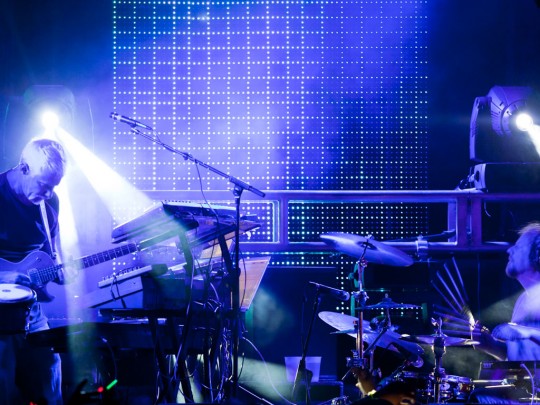
As electronic influences continue to penetrate the live rock, jazz, and jam ethos, one band . . . consistently rises to the top, bringing together fans from across the musical spectrum. EOTO crisscrosses the country blowing out basement dives, packed theaters, and stages under the stars. Check your festival schedules: this 100% improvised dubstep/breakbeat/house/drum & bass/trip-hop duo is the premier late-night party in the country.
Throbbing bass and thudding beats are the signatures of this project from drummers Michael Travis and Jason Hann. Born out of their shared love of electronic dance music, EOTO’s M.O. is to take the free-wheeling party vibe of a DJ set to the next level by using organic instruments, innovative performance technology, and uncharted musical exploration. Live drums, guitars, and keys, and vocals are mixed, remixed, and sampled on the fly using cutting-edge programs. This is all done without a script, and without a net.
Hann plays a hyper EQ’d drumkit, chock full of multi-touch screens and MIDI controllers, and throws a number of effects on his otherworldly vocal styles. Travis takes on subsonic frequencies, generating the band’s crushing low end with analog, digital, and software synthesizers, occasionally picking up guitar or a bass guitar and showing off his proficiency with instruments of all shapes and sizes.
Hann, has been playing percussion professionally since the age of 12. Years of collaborating, touring, and recording with the likes of Youssou N’Dour, Isaac Hayes, Dr. Dre, Loreena McKinnett, SCI, and a slew of other established artists running the gamut from Latin jazz to R ‘n’ B and soul allows him to move fluidly between styles. Adding to this is his depth in African and Latin drumming traditions, allowing the futuristic EOTO sound to keep itself rooted in the past.
For the last 16 years, Travis has been the drumming octopus in SCI. He morphs roles to melodic multi-instrumentalist in EOTO, providing the raw basslines and harmonic tapestry that fill out the soundscape of the duo. Both Hann and Travis have the chops and stamina for physically demanding, EOTO improvised sets, which have been known to go upwards of 4 straight hours. “When we’re playing live for 3 hours a night, it’s like playing tribal drums in a ceremony,” Hann explains. “I’m looking at one person at a time out there, and thinking ‘what can I do to make you dance?'”
[learn_more caption=”Click here to read more”]
An EOTO set is a nebulous beast. Setlists are only broken up into tracks for the sake of posterity. In reality, changes in mood, energy, and inspiration are reflected-in real-time-by rhythmic and melodic shifts. The duo moves effortlessly from choppy dubstep to whip-smart, four-on-the-floor house to psychedelic trip-hop. It’s a dance marathon, but everyone’s in it together. The EOTO set is dependent on crowd energy and activity, effectively breaking down the wall between artist and audience.
Because EOTO starts fresh every night, the band’s evolutionary progress has been thrust into hyperspeed, eclipsing standard acts who return to their dusty catalog for every performance. This is apparent when following the musical evolution of their live performances, which are recorded every night and made available to their fans. On EOTO’s first 2 studio releases–2006’s Elephants Only Talk Occasionally, and the 2008 release Razed, EOTO bounced playfully between house, trance, and breakbeat. A huge change in their sound came when Travis and Hann first saw, felt, and heard the cathartic vibes that dubstep could produce at DJ Skream’s set at Shambhala during the Summer of 2008. This influence saw the duo become the first National, live, dubstep act in the US. The wobbly, buzz-saw bass and heavy backbeat style has become a signature of their sets, as heard on their live recordings and on the 2009 studio release, Fire the Lazers!!! Newer material has the duo co-opting sounds from outside the realm of electronic music with scratchy punk riffs and fuzzy sludge metal bass.
While the recording of each album is no different than the live performance-completely improvised in one take-the records are an appetizer to the live performance. Hann and Travis are consummate road dogs, playing almost 200 shows a year. EOTO has played more than seven hundred unique showcases in 48 different states in the five years since the project’s inception. Each set is recorded and released (www.livedownloads.com ) so fans can capture their unique EOTO dance throwdown, reliving the experience again and again.
[/learn_more]
Learn More
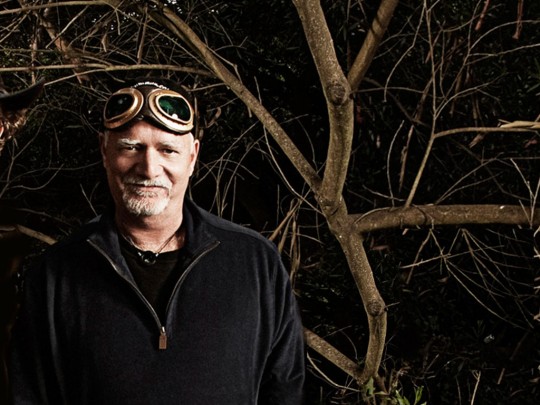
Drummer Bill Kreutzmann, best known as the steadfast heartbeat of the Grateful Dead from 1965 to . . . 1995, has devoted his life to stretching and surpassing the percussive limits of music. Armed with his signature dynamic rhythm and uncanny subtly, Kreutzmann’s lifetime pursuit has garnered him the reputation as an unequivocal, if enigmatic, backbeat.
Enigmatic because, during his four decade career with the Grateful Dead, and even since then, Kreutzmann has let his sweet rhythm and undeniable musical charisma do the talking. And that’s right where he’s most comfortable. He and fellow Grateful Dead percussionist Mickey Hart (who joined Kreutzmann and the band in 1967, making the Grateful Dead the first rock band to have two drummers), were together known as the “Rhythm Devils” due to their ability to send audiences into paroxysms of polyrhythmic ecstasy.
If such a thing as a psychedelic style of drumming exists, Kreutzmann arguably defined in all its extended percussive energy. His preference for a shuffle rhythm, he reckons in retrospect, is rooted in an early passion for the music of Fats Domino and Ray Charles. “I like to turn corners rapidly,” Bill says. “I like to establish a feeling and then add radical or oblique juxtapositions to that feeling.”
Learn More
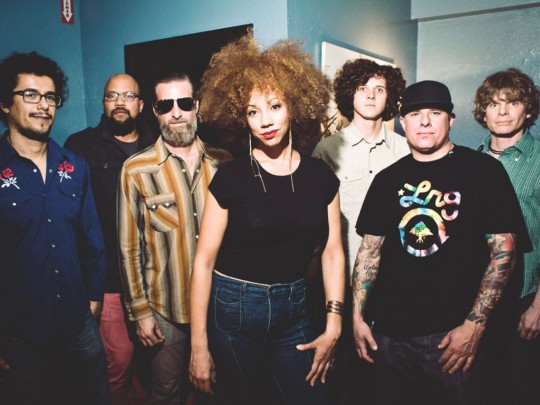
For over a decade, Orgone has been steaming up stages all over the country and drenching the biggest . . . music festivals in sweat. Now, the band is back in its home-grown studio KillionSound crafting and recording its seventh full-length album featuring their new powerhouse singer Adryon de Le’n. Orgone’s sound is a cold-blooded blend of deep soul, rare funk, and afro-disco with a raw rock star edge that is uniquely LA. Shifting effortlessly from slyly slinky to seismically cinematic, the music remains tough and uncluttered. For their heart-pounding live performances and classic, gritty recordings, Orgone has been called by Dusty Groove America, “One of the heaviest acts we’ve heard in years.”
Orgone is a synergy of eight musicians, at the core of which are keyboardist Dan Hastie and guitarist Sergio Rios who have been chiseling their distinctively timeless sound since their teens. “The present state of this band reflects the honesty and authenticity that we’ve always strived for in our music,” says Rios, “We’ve really hit a sweet spot in our dynamic.” Each band member shines in his own right, but together their chemistry results in a sweeping sound more tenacious than the sum of its considerable parts. Members of Orgone have collaborated/ performed with the Roots, Al Green, Gil Scott-Heron, Sharon Jones & the Dap-Kings, Breakestra, Thievery Corporation, and the Monophonics. Known for being air-tight in the studio, Orgone has been the backing band on numerous major label releases, most notably, Alicia Keys’ “As I Am” album and Cee Lo Green’s multiple Grammy Award-winning track “Fool for You.”
Click here to read more
Bringing fresh blood to the band is Adryon de LeÑn, a lightning rod whose bold, graceful vocals elevate the music to intoxicating new levels. This joining of forces was at once kismet and inevitable, according to de LeÑn: “Professionally, musically, spiritually, all paths led me to Orgone.” In 2014, Orgone continues to be a strong touring presence while tantalizing crowds with tastes of new material from their upcoming album, slated for release in the Fall of this year. Now and always, Orgone delivers dirty, organic soul with heart; music that grabs you by the collar, pulls you to your feet, and shoves you onto the dance floor.
Learn More
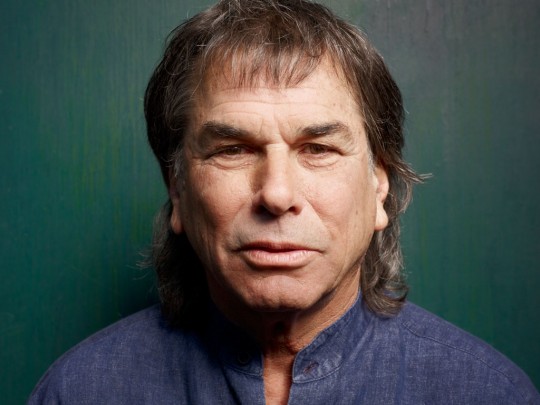
Mickey Hart is best known for his nearly three decades as an integral part of an extraordinary . . . expedition into the soul and spirit of music, disguised as the rock and roll band the Grateful Dead. As half of the percussion tandem known as the Rhythm Devils, Mickey and Bill Kreutzmann transcended the conventions of rock drumming. Their extended polyrhythmic excursions were highlights of Grateful Dead shows, introducing the band’s audience to an ever-growing arsenal of percussion instruments from around the world. Exposure to these exotic sounds fueled Mickey’s desire to learn about the various cultures that produced them.
In the past two years, Hart has sonified the Universe, the Golden Gate Bridge, the America’s Cup, and now, he is going even deeper. On his new record SUPERORGANISM, due out August 13, 2013, Hart is breaking new ground by combining music with science and the human body. “This time we journey into the micro, the hidden worlds of rhythm within us, within our bodies,” says Hart. “My brain wave signals are reimagined in sound using a cap with electrodes that can read the throbs and signals of the brain. I have also sonified the sounds of stem cells, and heart rhythms for this recording.” On SUPERORGANISM, Hart has once again paired up with longtime collaborator and Grateful Dead lyricist, Robert Hunter, as well as, many special guest musicians.
Each night of his upcoming SUPERORGANISM tour, Hart will perform a piece featuring the sounds of his own brain while wearing an EEG cap so the audience can visualize his brain activity in real time. To see an example of how this will work, watch Hart and neuroscientist Dr. Adam Gazzaley of UCSF at AARP in New Orleans last November here.
In celebration of Hart’s 70th Birthday in September, many of the upcoming SUPERORGANISM tour dates will feature guest musicians and friends of Mickey’s. Special guests the Tea Leaf Trio (Trevor Garrod, Reed Mathis, and Cochrane McMillan of Tea Leaf Green) will open the majority of the dates. Mathis will perform double duty each night playing with both the Tea Leaf Trio and the Mickey Hart Band.
[learn_more caption=”Click here to read more”]
Long a social activist, Hart appeared in August 1991 before the U.S. Senate Committee on Aging, speaking on the healing value of drumming and rhythm on afflictions associated with aging. With the help of Dr. Gazzaley, Hart, is continuing his Music Therapy research at the age of 69. “It all comes down to vibration and rhythm,” Hart says of his collaboration with Dr. Gazzaley. “This is about breaking the rhythm code. Once we know what rhythm truly does, then we’ll be able to control it, and use it medicinally for diagnostics, for health reasons. To be able to reconnect the synapses, the connections that are broken in Parkinson’s and Alzheimer’s, that’s where we are heading.” It’s just the beginning, as far as Hart is concerned. “I’ve been working in my field for many years and so has Adam, it’s a handshake between science and art. Life is all about rhythm, and the brain is Rhythm Central.” To learn more about Hart and Gazzaley’s collaboration, go to RhythmandtheBrain.com.
The Mickey Hart Band consists of Grammy winning percussionist and longtime band mate Sikiru Adepoju, Crystal Monee Hall (Tony Award Winning RENT), singer and multi-instrumentalist Joe Bagale, drummer Greg Schutte, guitarist Gawain Matthews, bassist Reed Mathis (Tea Leaf Green), and keyboardist/sound designer Jonah Sharp.
On October 11, 2011, Smithsonian Folkways Recordings released the ‘Mickey Hart Collection’ to preserve and further the Grateful Dead percussionist’s endeavor to cross borders and expand musical horizons. Smithsonian Folkways have made many of Mickey Hart’s music projects available digitally (stream and download) for the first time while keeping physical versions in print as on-demand CDs.
The Mickey Hart Collection begins with 25 albums drawn from ‘The World,’ a series Hart curated that incorporated his solo projects, other artists’ productions, and re-releases of out-of- print titles. Six of the twenty-five albums form the “Endangered Music Project,” a collaboration between Mickey Hart and the American Folklife Center at the Library of Congress, which presents recordings from musical traditions at risk. Both ‘The World’ and ‘The Endangered Music Project’ were previously distributed by Rykodisc from 1988 to 2002.
His tireless study of the world’s music led Mickey to many great teachers and collaborators, including his partners in Planet Drum Zakir Hussain, Babatunde Olatunji, and Airto Moreira. Planet Drum’s self-titled album not only hit #1 on the Billboard World Music Chart, remaining there for 26 weeks, it also received the Grammy for Best World Music Album in 1991– the first Grammy ever awarded in this category. Hart last released the Global Drum Project with Zakir Hussain, Sikiru Adepoju, and Giovanni Hidalgo in 2007, which took home the Grammy for Best Contemporary World Music Album.
Mickey’s experiences have paved the way for unique opportunities beyond the music industry. In 2008, he and Planet Drum partner Zakir Hussain composed a thrilling backbeat to the new Volcano at the Mirage Hotel in Las Vegas, NV. He composed a major drum production performed by an assembly of 100 percussionists for the opening ceremony of the 1996 Centennial Olympic Games. Additionally, Mickey has composed scores, soundtracks and theme for a number of award-winning films and television shows including Apocalypse Now, Gang Related, Hearts of Darkness, The Twilight Zone, the 1987 score to The America’s Cup: The Walter Cronkite Report, Vietnam: A Television History, and The Next Step.
Mickey has written four books documenting his lifelong fascination with the history and mythology of music. These include Drumming at the Edge of Magic, Planet Drum, and Spirit into Sound: The Magic of Music. His latest book, Song catchers: In Search of the World’s Music published by National Geographic Books, traces the 100-year evolution of recording technology, creating vivid portraits of the pioneers who traveled far and wide collecting the world’s music.
In 1991, Hart founded Rhythm For Life, and put on a 2000 person drum circle at the College of Marin, where he was joined by Carlos Santana, Shiela E, Hamza El Din, Airto, and Flora Purim, and in the Fall of 2004, broke the Guinness World Record: Largest Drum Ensemble for his 5000 person drum circle, also in Northern California. Mickey currently serves on the board of “Music and the Brain” at Institute for Music and Neurologic Function at Beth Abraham Hospital.
In 1999, Mickey was appointed to the Board of Trustees of the American Folklife Center at the Library of Congress where he headed the sub-committee on the digitization and preservation of the Center’s vast collections. There he helped to establish the “Save Our Sounds” project, a collaboration between the AFC and the Smithsonian’s Center for Folklife and Cultural Heritage, where he currently serves as member of the board of directors.
Mickey has been honored repeatedly for his contributions. The Grateful Dead was inducted into the Rock and Roll Hall of Fame in 1994, and in 2007 along with the other members of the Grateful Dead, Mickey received a Grammy Lifetime Achievement award. Other honors include, in 2009, Mickey was inducted into the Percussive Arts Society Hall of Fame. In 2004 he received the NARAS SF Chapter Governors Award, in 2002 Surround Music Awards Best Multi-track Reissue for Grateful Dead American Beauty, and in 2003 a Music Has Power Award, In October of 2000, the Saybrook Graduate School and Research Center conferred an honorary doctorate of humane letters upon Mickey for his work in advancing the preservation of aural archives.
[/learn_more]
Learn More
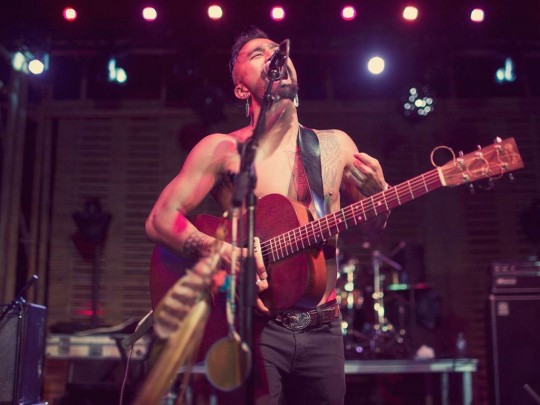
Oregon-native Nahko, born a mix of Apache, Puerto Rican, and Filipino cultures and adopted into an . . . American family, suffered an identity crisis from an early age. But the unifying power of music entered his life as a healing remedy, when he took up the piano at age six. Armed with his newfound talent, he set out to bridge the cultural gaps dividing his own psyche and began producing a public, musical journal of his journey toward personal, spiritual, and communal healing.
From his hometown of Portland to the shores of Hawaii or Bali, wherever he has traveled, Nahko is joined by a tribe of culturally alienated truth seekers for whom Nahko”s story resonates with their own, and who find redemption in his voice, guitar, flute, and drum. Whether solo or with the dynamic group of musical troubadours known as “Medicine for the People,” Nahko delivers a soulful dose of curative vibrations that moves audiences to dance, laugh, and cry. His “spirited redemption music” lays bear the scars of cultural wounds, environmental wrongs, and social injustices. His lyrics bear the burden of heavy messages, but the load is lightened by agile melodies and driving rhythms that coerce all who bear witness into spirited, purifying, movement. His humor disarms, and his lyrical stories open listeners to the power of “Real Talk Music”„songs that reveal an honesty and depth so raw, it inspires an internal revival that echoes out into the world. Sometimes exuberant, sometimes savage, but always transformational, Nahko makes the movement move.
Learn More
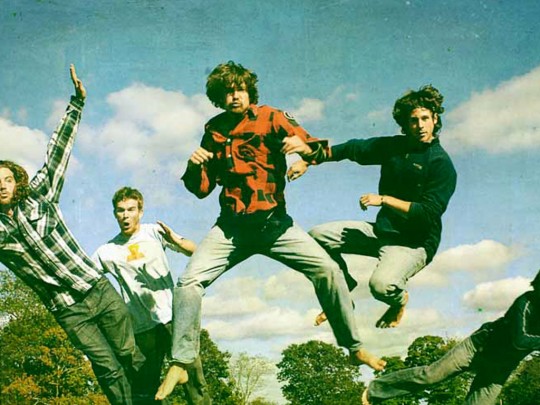
In the small New England town of Mystic, Connecticut, lives Barefoot Truth, an independent band that . . . is quietly creating history. You have never seen them on MTV, nor heard them on a Top 40 FM radio station, but with over 7 million spins on Pandora, Barefoot Truth has quickly become a symbol of independent music success, and just may be ‘the biggest band you’ve never heard of’. Mixing the sounds of folk, rock, jazz, and reggae, with lyrics full of unbridled optimism, the band has crafted a sound that is distinctly Barefoot Truth.
Since the band’s establishment during college, Barefoot Truth has been developing this signature sound that has virally spread through a grassroots following. With their lead singer on drums, and an array of unlikely roots-based instrumentation, the band translates their originality to their ever-evolving live show. The quintet features Will Evans on lead vocals and drums, John Waynelovich on piano, Jay Driscoll on Weissenborn slide guitar, Andy Wrba on upright bass, and Garrett Duffy on harmonica. It is not unlikely for members of the band to switch instruments mid-show, or even begin playing a didjeridoo, adding to the dynamic of the band’s sound.
Mixing a strong environmental message with the lofty theme of humankind’s interconnectedness on their 2010 studio album ‘Threads’, Barefoot Truth reached #21 on the iTunes Rock Charts, momentarily stepping ahead of bands such as Dave Matthews Band and The Fray. The new disc was noted as “The best independently released album of 2010” by ThisIsModern. Barefoot Truth happily credits Pandora Radio for their crucial role in growing the bandÍs silent army of listeners, as Driscoll recently stated in a USA Today article, “Pandora has basically created an avenue for us to have a career in music”.
Click here to read more
Since taking the band ‘full-time’ in 2007, after finishing college, Barefoot Truth has earned spotlight attention on many levels, including an invitation to play at President Obama’s pre-debate rally in New York, where they performed between Bruce Hornsby and Crosby and Nash. They were asked to lend several songs from their new album ‘Threads’ to the internationally acclaimed film ‘Nature Propelled’, in addition to scoring original music for the film. Barefoot Truth also lent their song ‘Threads’ to the video game ‘Rock Band’ (MTV Games).The band has also made appearances at major festivals such as Summerfest, 10,000 Lakes Festival, and FloydFest, in addition to tallying over 100 college and prep-school performances in the Northeast. Fans of Barefoot Truth can be confident that the quiet success of this small band will grow increasingly louder, one listener at a time…
In 2012, after many years of successful touring, the band rallied a final tour and went on hiatus. But by spring of 2014 and after countless letters from long-time fans, the band decided to return for a handful of summer dates, several of which sold out within days of being announced.
Learn More
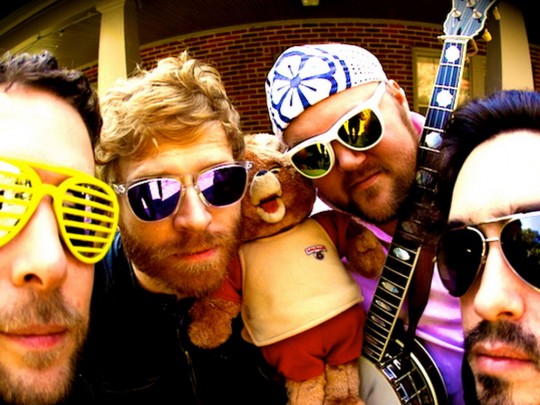
What do you get when you cross conservatory-trained musicians with raucous bluegrass and the . . . mega-hits of the 80s?
LOVE CANON
(intentionally spelled with one “N”)
Think Rocky IV, Cyndi Lauper, ZZ Top, Aha and Dire Straits played with banjo, mandolin and high lonesome vocals. It’ll make you laugh, it’ll make you dance, it’ll “blind you with science!”
“Love Canon doesn’t cover the music of the ’80s as much as kidnap it and take it on a bluegrass-tinged joyride. It’s a general rule of American culture that it takes 20-40 years for a decade to shed its stale stench and get its groove back. There’s no shortage of clever musical re-enactors giving the first generation of MTV an ironic makeover: a fool’s errand, given that the music already was soaked in postmodern irony. By contrast, Love Canon refreshes and extends the originals with affectionate humor and effortless virtuosity. The players „ including Old School Freight Train’s Jesse Harper, Nate Leath, Darrell Muller, Virginia Commonwealth University guitar and banjo master Adam Larrabee, and Mandolin Virtuoso Andy Thacker „ add layers of depth to the still-appealing pop hooks. They romp on throwaway classics such as ZZ Top’s “Legs” and “She Blinded Me With Science.” On their excellent version of “The Boys of Summer,” the folk instrumentation adds a traditional context to the time-capsule lyrics. After blazing through other up-tempo material, they shift to a slow burn on the closing “Girls Just Want to Have Fun.” It’s an unlikely choice for an all-male band, but they strip the song down to its bittersweet, feminist heart.” „ Peter McElhinney _ Style Weekly
Learn More
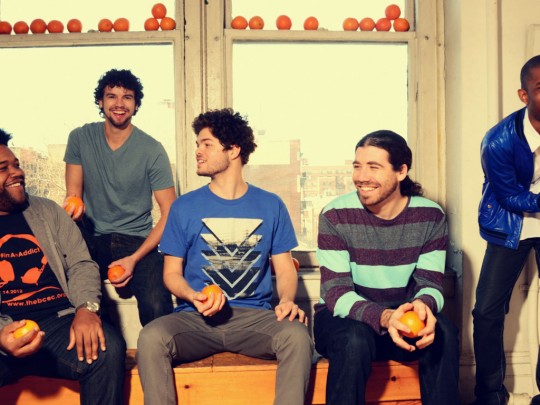
The Main Squeeze is a raging funk rock experience born in late 2009 from the thriving live music . . . scene of Bloomington, Indiana. Currently residing in Chicago, IL, The Squeeze boasts a unique sound and identity, seemlessly blending funk, rock, electro, and jazz with intricate jams, tight grooves, and ripping solos to create a live experience that audience members routinely describe as unparalleled.
Their exceptional ability to tackle and funkify such a wide variety of music makes each show an original experience in its own right. Infuse the musical tappestry with the soulful and powerful vocal stylings of formiddable lead singer Corey Frye and it is no surprise that at such an early stage in its development, the band has amassed a dedicated and rapidly growing national fan base. Since its birth, The Main Squeeze has already graced the stages of festivals such as Bonnaroo, Electric Forest, Macau International Jazz and Blues Festival (China), and Summer Camp among many others.
If youÍve ever wondered whether the juice is worth the squeeze, wonder no more – The Main Squeeze is sure to be hitting a city near you sometime soon, leaving their crowd funkified and freshly squozen.
Learn More
We’re extremely happy to welcome Digital Tape Machine to this year’s Gathering of the Vibes.
Digital . . . Tape Machine is a Chicago-based band featuring Kris Myers, Joel Cummins, Joe Hettinga, Bryan Doherty, David Arredondo, Marcus Rezak, and Dan Rucinski. The digital, yet analog force behind Digital Tape Machine produces a very modern, electronic sound. Often compared to video game music, elements of electronic dance, tech house, dance house, deep house, post-industrial, drum ‘n bass and hip-hop are all woven into a live show. This edgy, danceable music has been met by enthusiastic crowds who are thirsty for more. The band is rapidly gaining momentum from late night festival sets and sold out shows.
Learn More
McLovins specialize in the creation of dynamic and improvised sound, influenced by the members’ . . . disparate and eclectic musical influences. The band currently includes Jason Ott, Jake Huffman, Justin Berger and Atticus Kelly.
These College students from Connecticut embrace simultaneous and intricate improvisation with a more versatile front line in which all members are singing in four-part harmony, writing lyrics & music, as well as expounding on one another’s musical ideas. Set list segues and fiery improvisations are a staple of the band’s performances, keeping their audience always guessing what’s coming next and wanting more!
In the short time McLovins have been performing together, they have been invited to appear at an impressive number of well-established, as well as many new music festivals, and some of the most well respected venues in the North East. These guys are constantly writing & playing music, to continue to build on their own foundation, towards a long career of Original Rock Music to their growing fan base, of all ages.
Learn More
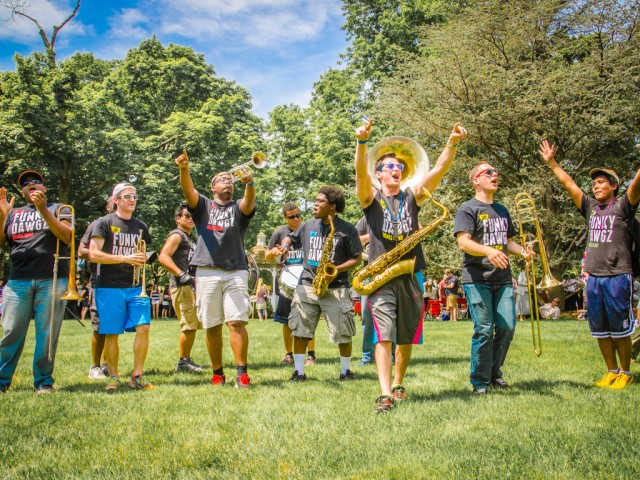
Featured on Live For Live Music’s Brass Bands You Need To Know, as well as on stage with Dispatch at . . . Madison Square Garden the Funky Dawgz have exploded onto the live music scene playing a mix of traditional New Orleans R&B, original music, and today’s top hits with a brass twist. One of the biggest up-and-coming touring acts these high energy horns are bound to get everyone around them dancing all night to that irresistibly funky music!
When the band is not playing shows they are giving back to the community! The Funky Dawgz aim to connect, engage, inspire and rejuvenate music education in inner city schools across the country. The band frequently gives performances and master classes to young musicians in elementary, middle, and high schools across the state.
Come see what the buzz is all about with the Dawgz by checking the tour dates! From the first beat of the bass drum to the last stroke of the snare, the Funky Dawgz Brass Band will always “Shut It Down”!
– Kroop will be point of contact for us going forwards. Please copy us in any communications as well! Thank you!
Learn More
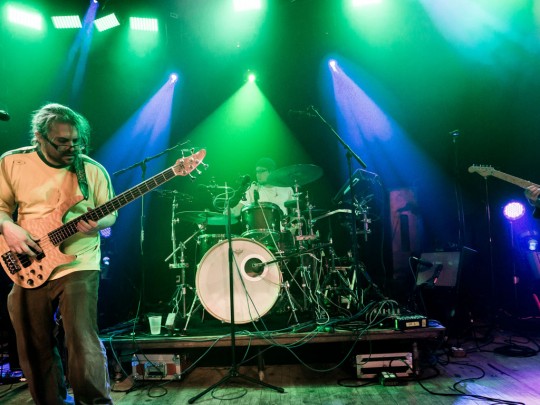
Congratulations to the 2014 Road to the Vibes winner, Cosmic Dust Bunnies!
Cosmic Dust Bunnies began . . . their interstellar journey in 2006, originally coming together for the purpose of improvisational exploration. They began to develop a sound and style that would soon evolve into the identity they embrace today. In addition to their New Wavetronica jams, CDB layers influences from Reggae, Dub, Funk, Rock, Pop, and everything in between to form an intimate bond with the audience. CDB’s rhythm section is comprised of Matt Beckett’s funky futuristic bass sounds and Eric Hyland’s precise timing on the acoustic and electric drums and loops. In addition, Matt Dempsey rips smooth and tasteful guitar licks while Chris Sellas blends in keys/synthesizers and sequences to complete their truly unique sound. These ever-evolving live performances have lead to packed houses at some of Connecticut, Rhode Island, and New York’s most well respected venues.
CDB has become a staple late-night act for such festivals as Catskill Chill, The Big Up, Ziontific, Rock N Roll Resort, Strange Creek and Wormtown and was also a part of the memorable City Bisco in Philadelphia hosted by The Disco Biscuits. CDB’s most recent album release “Skyward” is now available worldwide while fans from across the galaxy travel far and wide to experience the Cosmic Dust Bunnies.
Learn More
The Bobby Paltauf Band was founded by guitar prodigy Bobby Paltauf. At the age of 14-years-old, he . . . has already played with some of the most notable musicians the industry has to offer such as Buddy Guy, Ivan Neviile’s Dumpstaphunk, The Meter Men (Leo Nocentelli, George Porter, Jr, Zigaboo Modeliste w/Page McConnell), The Revivalists, DJ Logic, Twiddle, America, Kung Fu, Deep Banana Blackout, Jen Durkin, Andrew Gromiller, Anders Osborne, Stanton Moore, Papa Mali, Rob Mercurio, John Medeski, Lucky Peterson, Joe Tatton (New Mastersounds) and the Fundamensionals. And now adding all this to the newly formed band, Wow!
With Bobby’s and the bands, unique blend of blues, funk, rock and jam band sounds, has already earned them a great deal of attention on the scene and they have only just begun to make their mark. The band has just completed their first full length album entitled Lost And Found, which promises to impress music lovers near and far.
Learn More
Nick Depuy is a young and very talented singer/songwriter, a story teller with soul, influenced by . . . great muscians from Bob Dylan and James Taylor to Nick Drake and Jeff Buckley. He has had the privilege of opening for Neil Finn of Crowded House, Hall of Fame singer-songwriter Jimmy Webb, and the 2011 winner of the Voice, Javier Colon, receiving standing ovations for his performances. He has been featured on ABCÍs channel 8, on CBS radio WTIC 1080 and WPLR 99.1, and on several local cable network shows. Nick has played the music festival The Gathering of the Vibes in Connecticut, as well as at established music venues in New York City including the Rockwood Music Hall, The Living Room and JoeÍs Pub.
Discovered by the late Paul Leka (singer/songwriter/ producer known for Na Na Hey Hey / Harry Chapin/Dan Fogelberg), Nick has worked extensively with Bruce Lundvall, the retired chairman of and consultant to the Blue Note Label Group, now in the Universal Records family of labels. He has also had the good fortune to be mentor by Rosanne Cash on his songwriting.
NickÍs first EP is available on itunes/ amazon and his web site is www.nickdepuy.com
Learn More
The future of rock and roll has arrived and reveals itself through the music of four young up and . . . comers who call themselves, æThe New Breed. æWith a fusion of pop, rock and blues, The New Breed brings a youthful, energetic and infectious new sound that is filled with emotion and intent. The band is made up of 12 year old singer and song writer Nicky Dylan on guitar and lead vocals, 11 year old Brandon Niederauer on lead guitar and vocals, 13 year old Dylan Niederauer on bass guitar and vocals, and 14 year old Henry Thomas on drums. Formed in 2014, The New Breed plays mostly original songs influenced by a rich blend of music spanning across musical genres. If you want a glimpse into the future of rock and roll, come check out The New Breed.
Learn More
Pampalibros are: Brennan Prusak (15) on drums, Andrew Schur (15) on guitar, Ian Goodman (17) on . . . vocals, Zachary Schur (16) on bass, and Drew Sennett (15) on keys. They have been performing since 2009, at first playing mostly covers. After a couple of line-up changes they have settled down to a five membered band with a new focus and a common dedication to create original music. Inspired by classic rock, blending in influences from reggae and world music they are in and out of the recording studio for a soon to be released professional recording.
Learn More
Part-time B-Boy and self proclaimed frat star, turned professional poolside lounger pina colada . . . sipper. I make dance music sometimes.
I play a variety of house tunes with a tinge of R&B and hip hop influence. Not quite deep house but not quite disco either.
Learn More
Horizon Wireless blends psychedelic deep house and break-beat music with a variety of other styles . . . including progressive lounge, minimal tech-funk, and trance to create high energy and soulful dance sets. Seamlessly using elements from all across the sound spectrum, unique mixes are woven together throughout each show, creating a storm of soul smashing beats, titillating harmonies, and wet melodies. This sonic tsunami can easily induce multiple crowdgasms, so bringing a towel to shows is not only recommended, but encouraged as well.
This past half decade has been a very prosperous journey starting in New Paltz basements and Brooklyn lofts, and moving up through the circuit at 4G speed. Since then, Horizon Wireless has had the pleasure of playing countless shows at incredible venues such as Irving Plaza, The Capitol Theater, and even The Theater at Madison Square Garden this past New Years Eve. This will be the second Gathering of the Vibes set for Horizon Wireless, and you do NOT want to miss this VERY special and incredibly cosmic dance party. Trust us.
Learn More
The never ending quest for the ultimate groove has led Norrin from the bedroom to the dance floor . . . and everywhere in between. The mission is to bring you funk on a whole new level. Norrin takes on a versatile role in the music scene whether it was his time with Business Casual Disco, working with Gathering Of The Vibes and it’s beachside Silent Disco or founding Velvet Crush Records to name a few. Along the way Norrin has shared the bill with artists such as James Murphy, Aeroplane, !!!, Gigamesh, Budos Band, Goldroom, The B-52’s, Party Supplies and the list continues to grow.
Learn More
Risky Disko is the musical love child of Philadelphia DJs Greg D. and Crouse. Their journey began . . . through a mutual friendship and love for classic disco and house music. Using these genres as a framework for their sets, they take inspiration from whatever groove suits the mood. Pulling from funk and disco, to classic house and hip hop, this duo has taken the time to understand how the dance floor has changed over the years. Both strive for the new and different, no matter how classic or current the period is in which it originated. Their goal: to guide you on a journey through the decades…but be prepared…like all great journeys, there involves some element of RISK. Get (F)Risky!
Learn More
Business Casual Disco works to provide everyone with a delicate mixture of disco and house music . . . that will keep the feet moving and the head bobbing. Balancing time between production and DJ sets, the mixture of funky bass and driving synths keeps the music moving throughout the day and night. Think of it as the more tasteful side of dance music, like Playboy for your ears.
Learn More
Beam&Deem is the launchpad for the musical musings of Zach Catarelli and Chris Coffey. The . . . genre-dodging duo renders an array of styles and layers saturated with intricacy that play on blends of downtempo, glitch, idm, future garage and beats. The B&D live set is a curation of prerecorded material and showcases original tracks laden with unreleased efforts and edits that are often deconstructed and re-imagined for the listener, lending to a fresh experience that surfaces in each set.
Their latest studio effort ñJust Another Dayî, released in January of 2014, took their sound in an interesting new direction. Created in their West Philly studio, they combined lo-fi techniques with modern recording technology, using hardware and software synthesizers, samples and field recordings to create a dark, curious pallet of sound.
Learn More
Philadelphia (via Connecticut) musician/producer Matt Tripodi aka FLOTE has been making a name as . . . one of the east coast’s busiest producers as of late. In addition to serving up futuristic synth laced beats under his FLOTE moniker he also serves as 1/3 of the synth-pop-wave band Damn Right, not to mention an impressive amount of production, instrumentalist and mastering credits behind the scenes of tons of other artists’ albums. Known for his energetic live drum pad laden live shows, FLOTE has been perfecting his hip hop/juke/chillwave/house hybrid for years now while performing alongside acts such as Lapalux, Shigeto, Blockhead, Quantic, Washed Out, Groundislava, Giraffage, Emancipator, Count Bass D, Little People and countless others. After seeing a set it’s easy to see why so many are hailing him one of the east coast’s most original musicians.
Learn More
An evening with ConnetICON acts as an intense journey that can be characterized by deep grooves and . . . scintillating bass lines. Each set patiently and flawlessly weaves in and out of melodies, producing an ethereal, euphoric feel, either on the dance floor or in your headphones. Since the onset of his DJing career in late 2010, ConnetICON has quickly established himself, supporting major act’s such as Tiger and Woods, Break Science, Cinnamon Chasers, Orchard Lounge, Edit Murphy, Abakus, Goldroom, Emancipator, and Little People.
In the summer of 2012, ConnetICON further established himself as an integral member of the contemporary music scene, with his name featured on bills including, but not limited to, Camp Bisco XI, Gathering of the Vibes, Tipper Sound Experience, and Heads in Harmony II Festival, as well as various venue and club bookings.
A DJ set acting as a canvas, For a CONstructed soundscape
Learn More
MoPo is a master craftsman and his building material is the world’s most precious commodity: TIME. . . . Consider yourself fortunate If you get a chance catch a Motion Potion DJ set these days. An enormous amount of thought, planning, and scheming has to occur to make them happen. MoPo approaches his shows like a college professor, or a football coach, putting hours of preparation and thought into exactly who will be listening, and how exactly to reach into their souls. Every set is different, and each can unfold in hundreds of different ways, and this intense focus on preparation makes him so versatile, so intense, and so much damn fun. These are “DJ sets” in the classic sense, unfolding like poems with every song a word and every mix or drop a bit of punctuation. Once known as the “DJ for people who hate DJ’s” it would be more accurate to say that this is the DJ for those who love live music.
Some artists choose their craft, some are born to it, and yet others find that their path chooses them, almost by some accident of fate. For Robbie Kowal that accident took place in the summer of 1995 when seeking part-time employment in the Greek Islands to finish a book he was writing. Asked to substitute for a club’s regular DJ for a week, he was shocked when the club owner fired that DJ and hired Kowal instead. The next 180 days granted him less than 60 records to work into 178, 5-hour, marathon nights of music, and only two exhausted days off. His material was limited, the gear was terrible, but the challenge led him to a cross-genre aesthetic that has defined him ever since, and earned him a passionate fan-base. Called “The DJ for people who hate DJs” by SF Weekly,MoPo’s willingness to literally explore any type of music, has made him the subject of experimental whimsical missions for many a promoter and led to yet further esoteric musical avenues of his own divination.
But in the beginning it was always about the FUNK. It was the funk he fell in love with as a college student in New Orleans in the 90’s learning to dance at local brass band shows. After going to Greece in ’95, being Shanghaied into the world of DJing and a few others pitstops, MoPo landed in San Francisco in 1997.T o his great surprise, his fresh, genre-bending style soon landed him his first residency at the legendary SF dance dive Nicky’s BBQ. His Thursday Whatdafunk residency lasted more than 6 years in which time his study of the funk in all its forms reached an almost obsessive, fetishistic level. Combining his love of writing with the residency, MoPo would prepare and deliver a weekly “Whatdafunk Newsletter” to educate the visitors on the night’s focus, whether it be “Bootsy” “Earth Wind & Fire” “Latin Funk” or “Child Stars: Michael vs Stevie” etc etc. The night eventually morphed into a Friday night residency devoted to underground hip hop known as The Real.WhatDaFunk Newsletter became an email list, which soon had thousands of followers and suddenly MoPo became one of the Bay Area’s early intraweb tastemakers.
CLICK HERE TO READ MORE
Not satisfied with simply playing the music of his heroes, he co-founded the SF Funk Festival to bring them to SF, which led him also to co-found Sunset Promotions (nowHUSHconcerts ). Since the 1997 founding, Sunset has produced over 1000 concerts and operates not only SFFunk but also legendary New Years event Sea of Dreams , the Halloween artfest Ghost Ship and North Beach Jazz, All Shook Down and Spectrum festivals. Through it all, he satisfied his passion for the funk by working with, among others, James Brown, Parliament Funkadelic, Bootsy Collins, Morris Day & the Time, and producing reunions for Fred Wesley & the JB’s, the Family Stone and Mandrill.
His passion for psychedelic rock made him the first DJ asked to play seminal rock festivals such as High Sierra and Gathering of the Vibes and earned him invitations to play Jamcruise II and dozens of Phish, Allman Brothers, and Widespread Panic after-parties in New York’s vibrant post-Wetlands jamband scene. This led to the Syn parties, where MoPo spent months gathering, studying, and experimenting with the live-recordings of the new generation of psychedelic rock acts like STS9, Disco Biscuits and of course Phish. In time, this, and his deep skills with funk, soul and disco would lead him to an invitation to play the Bonnaroo Music & Arts Festival in 2002, an invitation he would have the honor to receive for a record 9 consecutive years. But from 2002-2004, MoPo was the festival’s only DJ, rocking 5-hour nightly sets in the Arcade. In 2005, Bonnaroounveiled the USA’s first Silent Disco production and MoPo was the guinea pig, beginning a passionate love affair with the emerging technology that would last to this day. His 2007 launch of the massively successful Silent Frisco is a testament to his passion for the format.
2004 also led him back to the Burning Man Festival where he was faced with his first real artistic roadblock. Literally dragged to this hotbed of progressive club music to play rare groove and hip hop, he found himself under-armed for a world that bopped hardest at 4am. Said MoPo “I remember wishing I had harder, faster, and bigger tracks and, really for the first time ever, feeling a bit underwhelmed by the funk. I felt like I had brought a knife to a gunfight.”
The experience sent him on a deep dive into electronic music, searching for answers to his “need fatter funk” dilemma. Not satisfied with simply playingstraight-up EDM records, he dug far and wide for tracks that could bridge the gap between his funk/rock style and the newer beats that propel the late-night. Thankfully, this search coincided with many a technical and artistic development, including the one that brought such funk/rock/disco-drenched producers as LCD Soundsystem, Unkle, Kraak & Smaak, and Fort Knox 5 to the forefront. The development of tempo-taming production technology like Ableton Live led to an explosion of mashup/remix culture that has since allowed MoPo to stay thematically on mission but tether his funk, rock, and disco to beats and bass-lines as fat as any.
With these production tools at his command, in 2004, MoPo unveiled his own first tentative, somewhat raw attempts at production. Although his skills were crude, the arrangements were born of a decade of DJing and thus many of the mash-ups, cut ups and remixes he released at the time found huge regard. Among them were the first of his many Radiohead-related releases “Just Break” which was featured on BootieUSA’sseminal The Best Mashups in the World Come from San Francisco. His annual trips to Bonnaroo led to tracks based on the festival’s lineup including work devoted to Phish, Widespread Panic, Dave Matthews, and Buffalo Springfield, all of which would be released as the “Bonnaroo Bangers ” compilation.
Other, more advanced explorations saw him focus tracks around themes of specific emotions or settings. Thus emerged Saturdazed, featuring 7 different Saturday-related samples or the breakbeat workout Conflageration which uses6 different tracks about fire. All of these would be featured on the 3-EP series he released on 2008 entitledElectric Nostalgia Vol. 1-3. This propelled more than 3 years of touring (while simultaneously running both SunsetSF and launching Silent Frisco). The progressive rocker now found himself invited for the first time to electronic festivals like Shambala,Camp Bisco, and WMC Miami. Clubs in Spain, Holland, France, Germany, and more than 40 US States welcomed MoPo and his enthusiastic, eclectic and inclusive approach to dance music.
To some degree exhausted by this pace and the 2010 loss of his beloved mother, MoPo decided to spend more time in San Francisco, which led to further focus on Silent Frisco and SunsetSF. A 3- year run in a monthly Silent Frisco residency in Santa Monica led to deeper investigations of the music of Radiohead, James Brown, Widespread Panic, Talking Heads and P-Funk and planned EP releases and mixtapes to deal with each. In 2015, he merged SunsetSF and Silent Friscoand launched HUSHconcerts .
Learn More
MoPo is a master craftsman and his building material is the world’s most precious commodity: TIME. . . . Consider yourself fortunate If you get a chance catch a Motion Potion DJ set these days. An enormous amount of thought, planning, and scheming has to occur to make them happen. MoPo approaches his shows like a college professor, or a football coach, putting hours of preparation and thought into exactly who will be listening, and how exactly to reach into their souls. Every set is different, and each can unfold in hundreds of different ways, and this intense focus on preparation makes him so versatile, so intense, and so much damn fun. These are “DJ sets” in the classic sense, unfolding like poems with every song a word and every mix or drop a bit of punctuation. Once known as the “DJ for people who hate DJ’s” it would be more accurate to say that this is the DJ for those who love live music.
Some artists choose their craft, some are born to it, and yet others find that their path chooses them, almost by some accident of fate. For Robbie Kowal that accident took place in the summer of 1995 when seeking part-time employment in the Greek Islands to finish a book he was writing. Asked to substitute for a club’s regular DJ for a week, he was shocked when the club owner fired that DJ and hired Kowal instead. The next 180 days granted him less than 60 records to work into 178, 5-hour, marathon nights of music, and only two exhausted days off. His material was limited, the gear was terrible, but the challenge led him to a cross-genre aesthetic that has defined him ever since, and earned him a passionate fan-base. Called “The DJ for people who hate DJs” by SF Weekly,MoPo’s willingness to literally explore any type of music, has made him the subject of experimental whimsical missions for many a promoter and led to yet further esoteric musical avenues of his own divination.
But in the beginning it was always about the FUNK. It was the funk he fell in love with as a college student in New Orleans in the 90’s learning to dance at local brass band shows. After going to Greece in ’95, being Shanghaied into the world of DJing and a few others pitstops, MoPo landed in San Francisco in 1997.T o his great surprise, his fresh, genre-bending style soon landed him his first residency at the legendary SF dance dive Nicky’s BBQ. His Thursday Whatdafunk residency lasted more than 6 years in which time his study of the funk in all its forms reached an almost obsessive, fetishistic level. Combining his love of writing with the residency, MoPo would prepare and deliver a weekly “Whatdafunk Newsletter” to educate the visitors on the night’s focus, whether it be “Bootsy” “Earth Wind & Fire” “Latin Funk” or “Child Stars: Michael vs Stevie” etc etc. The night eventually morphed into a Friday night residency devoted to underground hip hop known as The Real.WhatDaFunk Newsletter became an email list, which soon had thousands of followers and suddenly MoPo became one of the Bay Area’s early intraweb tastemakers.
CLICK HERE TO READ MORE
Not satisfied with simply playing the music of his heroes, he co-founded the SF Funk Festival to bring them to SF, which led him also to co-found Sunset Promotions (nowHUSHconcerts ). Since the 1997 founding, Sunset has produced over 1000 concerts and operates not only SFFunk but also legendary New Years event Sea of Dreams , the Halloween artfest Ghost Ship and North Beach Jazz, All Shook Down and Spectrum festivals. Through it all, he satisfied his passion for the funk by working with, among others, James Brown, Parliament Funkadelic, Bootsy Collins, Morris Day & the Time, and producing reunions for Fred Wesley & the JB’s, the Family Stone and Mandrill.
His passion for psychedelic rock made him the first DJ asked to play seminal rock festivals such as High Sierra and Gathering of the Vibes and earned him invitations to play Jamcruise II and dozens of Phish, Allman Brothers, and Widespread Panic after-parties in New York’s vibrant post-Wetlands jamband scene. This led to the Syn parties, where MoPo spent months gathering, studying, and experimenting with the live-recordings of the new generation of psychedelic rock acts like STS9, Disco Biscuits and of course Phish. In time, this, and his deep skills with funk, soul and disco would lead him to an invitation to play the Bonnaroo Music & Arts Festival in 2002, an invitation he would have the honor to receive for a record 9 consecutive years. But from 2002-2004, MoPo was the festival’s only DJ, rocking 5-hour nightly sets in the Arcade. In 2005, Bonnaroounveiled the USA’s first Silent Disco production and MoPo was the guinea pig, beginning a passionate love affair with the emerging technology that would last to this day. His 2007 launch of the massively successful Silent Frisco is a testament to his passion for the format.
2004 also led him back to the Burning Man Festival where he was faced with his first real artistic roadblock. Literally dragged to this hotbed of progressive club music to play rare groove and hip hop, he found himself under-armed for a world that bopped hardest at 4am. Said MoPo “I remember wishing I had harder, faster, and bigger tracks and, really for the first time ever, feeling a bit underwhelmed by the funk. I felt like I had brought a knife to a gunfight.”
The experience sent him on a deep dive into electronic music, searching for answers to his “need fatter funk” dilemma. Not satisfied with simply playingstraight-up EDM records, he dug far and wide for tracks that could bridge the gap between his funk/rock style and the newer beats that propel the late-night. Thankfully, this search coincided with many a technical and artistic development, including the one that brought such funk/rock/disco-drenched producers as LCD Soundsystem, Unkle, Kraak & Smaak, and Fort Knox 5 to the forefront. The development of tempo-taming production technology like Ableton Live led to an explosion of mashup/remix culture that has since allowed MoPo to stay thematically on mission but tether his funk, rock, and disco to beats and bass-lines as fat as any.
With these production tools at his command, in 2004, MoPo unveiled his own first tentative, somewhat raw attempts at production. Although his skills were crude, the arrangements were born of a decade of DJing and thus many of the mash-ups, cut ups and remixes he released at the time found huge regard. Among them were the first of his many Radiohead-related releases “Just Break” which was featured on BootieUSA’sseminal The Best Mashups in the World Come from San Francisco. His annual trips to Bonnaroo led to tracks based on the festival’s lineup including work devoted to Phish, Widespread Panic, Dave Matthews, and Buffalo Springfield, all of which would be released as the “Bonnaroo Bangers ” compilation.
Other, more advanced explorations saw him focus tracks around themes of specific emotions or settings. Thus emerged Saturdazed, featuring 7 different Saturday-related samples or the breakbeat workout Conflageration which uses6 different tracks about fire. All of these would be featured on the 3-EP series he released on 2008 entitledElectric Nostalgia Vol. 1-3. This propelled more than 3 years of touring (while simultaneously running both SunsetSF and launching Silent Frisco). The progressive rocker now found himself invited for the first time to electronic festivals like Shambala,Camp Bisco, and WMC Miami. Clubs in Spain, Holland, France, Germany, and more than 40 US States welcomed MoPo and his enthusiastic, eclectic and inclusive approach to dance music.
To some degree exhausted by this pace and the 2010 loss of his beloved mother, MoPo decided to spend more time in San Francisco, which led to further focus on Silent Frisco and SunsetSF. A 3- year run in a monthly Silent Frisco residency in Santa Monica led to deeper investigations of the music of Radiohead, James Brown, Widespread Panic, Talking Heads and P-Funk and planned EP releases and mixtapes to deal with each. In 2015, he merged SunsetSF and Silent Friscoand launched HUSHconcerts .
Learn More
Made up of Frank Cueto and Rusty Belicek, the All Good Funk Alliance has opened up for legendary . . . artists and DJs, written songs for commercials , T.V. and movies and constantly appear on the Breakspoll Top 50 list. In other words, these guys are no strangers to the funk. And while their musical tastes range the gamut, when Frank and Rusty join forces the end result is always the same: they deliver a sound that is funky, fun and fresh.
All Good Funk Alliance has long been lauded by critics and fans alike, and DJs looking to inject flavor into their sets invariably seek out that unmistakable AGFA sound. Their remix of big band legend Woody Herman’s track, “Mambo Herd,” was met with critical acclaim, and the boys recently signed a major remix deal to put their indelible, funk-infused spin on Kraak and Smaak’s hit album ñPlastic People.” When AGFA’s release, “REC,” dropped in 2007, Properly Chilled described it as “modern funk mixing the best of hip hop and funk [with] lots of percussion breakdowns.” Turntable Lab has also raved about the duo’s sound, summing it up as: ñcontinually hitting the head-nodding nape.”
Since 1999, All Good Funk Alliance has released music on a host of labels, including its own heavyweights: Funk Weapons, Super Hi-Fi Recordings and Baffin Island Beat Brigade. Frank and Rusty have played at clubs and festivals around the globe„from Canada to Australia„and the pair has even opened up for the iconic godfather of soul himself, James Brown.
Recognized as influential pioneers of the Nu-Funk and mid-tempo breaks sounds, AGFA’s innovation and originality has earned them universal respect across the music industry. They are constantly dropping new remixes, originals and reworks brimming with hype music that encompasses multiple genres, the All Good Funk Alliance are keeping it fresh while keeping true to their roots musically.
Learn More
Thomas is known for his skill as both a producer and a DJ based in Washington, DC. His tracks . . . reflect the ease with which he moves from genre to genre when he mixes sounds in his studio and his remixes successfully take on the challenge of incorporating international melodies with steady beats that his followers can dance to.
Starting his career as a DJ in the 1990s dance music scene in Washington, DC, Thomas has infused just about every type of beat-oriented genre such as deep house, speed garage, drumÍnÍbass, hip-hop, reggae, and dub with Arab, Latin, Indian, Balkan, Kurdish and Caribbean influences. This musical aptitude has served him well both in the studio and the DJ booth as today he maintains a Sunday night residency at DCÍs headquarters of everything organic, Eighteenth Street Lounge.
Through his label Rhythm & Culture, Thomas Blondet has released the European Coaster EP and chilltempo Echo Chamber EP. He has since released several hand-crafted remixes of music by Balkan Beat Box, Nickodemus, Sola Rosa, Mr. Confuse and Fort Knox Five.
Look out for upcoming remixes, tracks and live DJ sets by the man who never stops working and doesnÍt set limits on his level of creativity. More info on Tom is available online via Thomas BlondetÍs website.
Learn More
For DJ Lady Verse, simply being the premier female DJ in New York’s Hudson Valley doesn’t cut it. . . . Her aim is much, much higher. Throughout her eleven-year career, this spinstress has toiled tirelessly behind the turntables, focusing hard on developing her impeccable song selection and seamless mixes. And it shows, just ask the legions of orgasmically satiated dancers from over 100 venues that she has rocked from NYC to Miami and beyond. With over a dozen long-term residencies under her belt, DJ Lady Verse is a regular at New York City’s largest nightclub, Webster Hall. She has earned her place in a predominantly male field and worked her way up the ranks, gaining the respect of both her fans and peers.
Learn More
Brooklyn-based DJ/producer ILLEXXANDRA (http://illexxandra.com) brings a consistently fun party . . . vibe, drawing from the worlds of funk, UK future sound, global bass, electro swing, and classic club culture. Her sets draw you in with innocent joy, smack you around with raw ferocity, and then set you down gently with deep musical knowledge. SheÍll kill it with an hour of bangers, or take you on a five-hour journey into sound.
Learn More
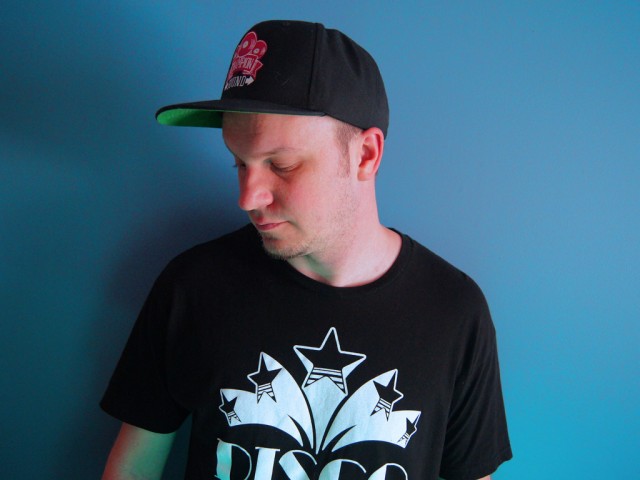
Jason Brown AKA Jayclue is Qdup, and has been making dance floors groove and butts move worldwide . . . since late 2006. Over the years, Qdup has released top selling tunes and remixes on many well received labels including Bombstrikes, Fort Knox Recordings, Bombastic Jam, Goodgroove, Air, ESL Music, Royal Soul, MustBeat and his own Qdup Records imprint.
Having remixed the likes of Fort Knox Five, DJ Love, Thunderball, Basement Freaks, All Good Funk Alliance and Ursula1000 to name a few, Qdup has garnered a spot as one of the most in demand artists for remixing friends of funk and breaks. Also known for his party mashing exclusive edits and re-rubs, he has gained a following via some of the webs hottest blogs, dropping secret weapon DJ tunes.
As an established tastemaker, Qdup has been a contributor to the UK based Ghetto Funk blog since it’s inception and has produced several tracks on their Icons series remix albums. 2013 saw Qdup break out on the summer festival scene in North America including Shambhala (Salmo, BC), BassCoast (Merritt, BC), Firefly Fest (DE, USA), Art Outside (TX, USA) and P.E.X. (MD, USA). With additional releases upcoming on Fort Knox Recordings, new collaborations, remixes, free downloads and DJ mixes in the works, 2015 is lining up to be a busy year for Qdup.
Learn More
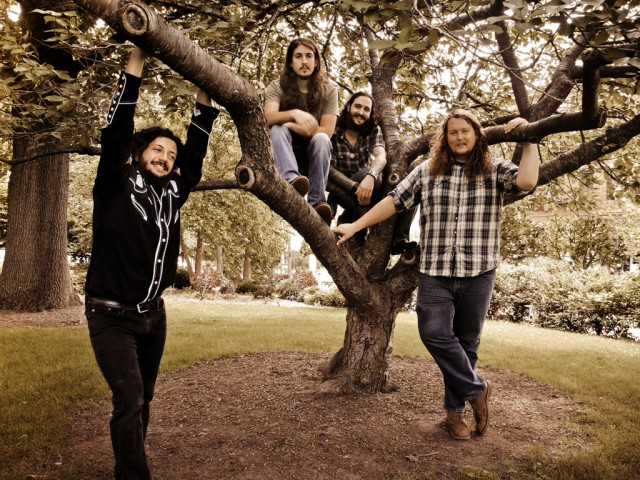
Bursting on to the scene mid-2012, The Brummy Brothers’ inspiring rhythms, infectious melodies, and . . . undeniable ability to plow through a set with fiery passion and intensity keep them busy with over 100 shows a year up and down the East Coast.
The New Jersey natives’ original blend of bluegrass, rock, and improvisation forms a sound and energy that allows them to be found playing anywhere from rock clubs, to folk festivals, to farmers markets. And it’s a good thing, because if one thing is clear, it’s that these guys love to play music.
In May 2014 The Brummy Brothers released their debut album “On Our Way” produced by Tim Carbone of Railroad Earth. The album allows the band to share the composite of their time together. The record incorporates harmonizing voices, striking instrumental prowess, and expert arrangement to bring everything together.
Andrew Morris – Guitar, Vocals
Dave Brumberg – Bass, Vocals
Eric Brumberg – Mandolin, Vocals
Russell Gottlieb – Banjo, Vocals
Fans just can’t wait to, “Shake their BRUM!”
Learn More
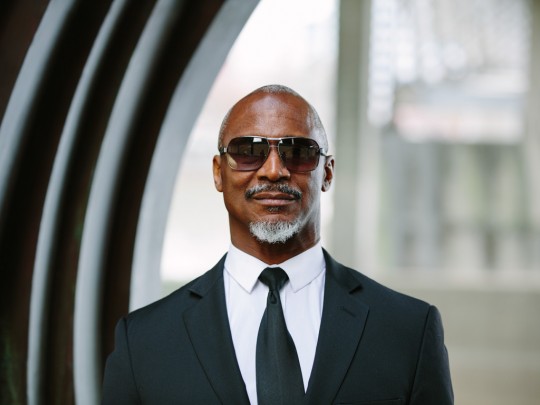
San Diego-based, iconic performer Karl Denson is set for another busy summer. With his own band, . . . Karl Denson’s Tiny Universe, he’ll play a number of select theatre dates and high profile festivals across the U.S. The shows will have added significance, as drummer Alan Evans (best known for his work with Soulive) will be joining the Tiny Universe. Denson will also play a handful of dates with The Greyboy Allstars, the seminal boogaloo revivalist band he co-founded in the early ‘90s. In addition, he’ll return to the fold in his recurring role as saxophonist in The Rolling Stones and Slightly Stoopid for a slew of summer shows.
Karl Denson’s most recent recorded work can be heard on the Tiny Universe LP, New Ammo. The collection showcases the grittier side of the band’s musical oeuvre, including stand outs like “My Baby” featuring singer Nicki Bluhm, ”Everybody Knows That” and his raucous rendition of The White Stripes “Seven Nation Army.” The album has received wide acclaim: All Music declared the effort, “easily their most musically adventurist album yet,” while DownBeat praised it as “music for both the party and for fans of instrumental prowess.”
Approaching two decades strong, Karl Denson’s Tiny Universe is a prolific touring juggernaut that regularly performs over 150 shows annually. They’re currently working on material for a new studio album to be released later this year. Denson himself is an acclaimed and highly in-demand saxophonist and songwriter who first came to national attention as a member of Lenny Kravitz’s Let Love Rule-era band.
Learn More
As campers and fans set-up camp and find friends old and new on Thursday, it’s certainly one of the . . . most asked questions around the park; “What set do you think DSO will perform tonight?”
Dark Star Orchestras shows are built off the extensive catalog of the Grateful Dead. On any given night the band will perform a show based on a set list from the Grateful Dead’s 30 years of extensive touring or use the catalog of original songs and often played covers to create a unique set list for the show. This allows music fans both young and old to share in the experience.
Dark Star Orchestra presents its critically acclaimed live show at esteemed venues from coast to coast and internationally. Grateful Dead classics are performed in the same way that an orchestra interprets music of classical composers. The composer spirit is derived and channeled as the players capture the excitement and innovation of the original performances and compositions.
CLICK HERE TO READ MORE
Touring nationwide for over 15 years to the tune of nearly 2200 shows since forming, the band’s determined commitment to “raising the Dead” has drawn national media attention. On any given night the band will perform a show based on a set list from the Grateful Dead’s 30 years of extensive touring or use the catalog of original songs and often played covers to create a unique set list for the show. This allows music fans both young and old to share in the experience. Grateful Dead classics are performed in the same way that an orchestra interprets music of classical composers. The composer spirit is derived and channeled as the players capture the excitement and innovation of the original performances and compositions. Following each performance the band announces the date and venue of the original performance.
The current incarnation of DSO includes lead guitarist Jeff Mattson and rhythm guitarist Rob Eaton, drummers Dino English and Rob Koritz, bassist Kevin Rosen, Keyboardist Rob Barraco and harmony vocalist Lisa Mackey, Once again, we’re proud to welcome back DSO for a performance dedicated to the forbearers of the jam scene and the inspiration for this festival, The Grateful Dead.
Learn More
This eight piece musical outfit was notorious for performing musical compositions ranging from Tower . . . of Power, Sly and the Family Stone to the likes of Funkadelic. Deep Banana Blackout has sold out such venues as the Webster Theater in Hartford, Connecticut (1200 capacity) and Irving Plaza in New York City (1100 capacity). With a full horn section and a soulful, funky groove DBB’s infectious sound is a combination of old school funk, Latin salsa, jazz and rock music.
They were featured at the Newport Jazz Festival in the summer of 2000, as well as being the focal point of a feature article in JazzTimes. All four DBB albums were locally produced and distributed, with Live in the Thousand Islands selling well over 5,000 copies.
A Gathering of the Vibes festival wouldn’t be complete with out this funktastic band on the line up, and we’re fired up to get the funk out with Deep Banana Blackout once again!
Learn More
Blurring the lines between electro-jazz-fusion and ’70s-style street fighter funk, Kung Fu merges . . . early Headhunters and Weather Report mentality with contemporary electronic ideology like yin and yang. Although the ensemble cast enjoys a seasoned pedigree that reads like an all-star jam, Kung Fu has gained a rabid following that has led to sold out club shows around the US and sets at major music festivals. The powerhouse quintetÍs live show has been described as “lethal funk”, “explosive”, “jaw dropping”, and “musically mesmerizing”. With several tracks from their self-titled 2011 debut album already on regular rotation on Sirius/XM Radio’s JamOn, their highly anticipated follow-up album, Tsar Bomba, dropped March 4, 2014.
Learn More
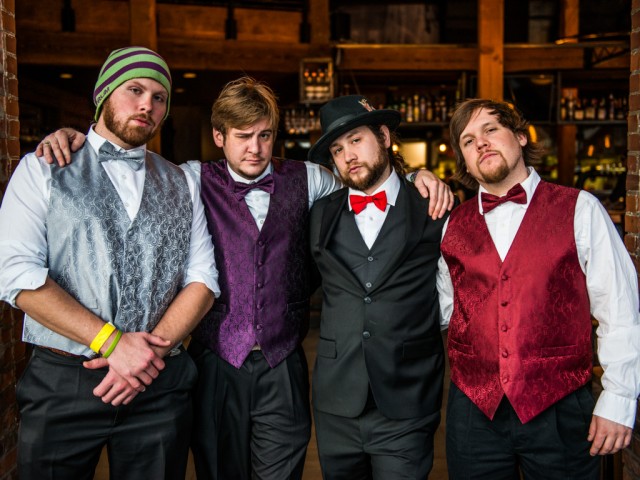
Twiddle, a Vermont-based quartet, dismantles most preconceived notions of jam band culture. Their . . . fresh multi-genre approach conjures up rock, jazz, and bluegrass, but above all, masterfully blends reggae and funk.
After whimsically jamming in the fall of 2004, the founding members of Twiddle immediately recognized creative chemistry. By their second semester at Castleton State University, Mihali Savoulidis and Ryan Dempsey were carefully intertwining harmony and fantasy, birthing band staples like “Frankenfoote” and “ Gatsby the Great”.
Twiddle took Castleton by storm, toured the northeast, and composed a catalog of original music before becoming upperclassmen. 2007 manifested Twiddle’s debut release, The Natural Evolution of Consciousness. This breakout album showcased the band’s eclectic inspirations, imaginative lyrical abilities, and superb instrumentation. Twiddle’s sophomore production, 2011’s Somewhere on the Mountain, delves into the human spirit, speaking to our ambition, grief, and love. Their latest production, Live at Nectar’s, is a double disc live album recorded in August of 2013 at Burlington, Vermont’s Nectar’s. A clear hallmark of their career, Live at Nectar’s truly captures Twiddle in their element, the live experience.
Currently Twiddle is shooting up the rows of festival lineups, packing prominent theaters, and inspiring each other. With sage songwriting and unmatched variety, Twiddle continues to exceed all expectations.
Learn More
Originally formed at the University of Vermont as an acoustic duo “Strange Folk” in 1991 with . . . Trafton and other founding member Reid Genauer, Strangefolk (now one word) added bass and drums within a year and took to playing the bars in and around the vibrant musical community of Burlington, Vermont. After only a couple years of developing their signature sound in and around the Vermont music scene, the band began touring the club and college circuit around the Northeast, quickly gaining momentum and popularity with each tour. Regional tours paved the way for national tours, with the band logging over 100 shows per year. In 1998, Strangefolk signed with Mammoth Records, only to have the record deal collapse when Disney purchased Mammoth in 1999. “A Great Long While”, which was to be the band’s major-label debut and was produced by Nile Rodgers, was released independently in 2000.
Learn More
In his 10-year career this gifted singer and his limber band have built their catalog the . . . old-fashioned way, by introducing new songs to their live set, then bending and shaping them over dozens of performances before committing a definitive version to the hard drive.
For that and many other reasons, Montbleau’s latest album, “For Higher”, is quite literally a departure. Well-established out of his home base in the Northeast, the singer threw himself into New Orleans, where everything is slow-cooked, for a few fast-moving days, and whipped up an instant delicacy.
A few of the cuts on the new album, the playful stomp of “Deadset” or Head Above Water, freshly peppered with horns, were already part of the Ryan Montbleau Band’s ever-growing repertoire. But the majority, including four handpicked cover tunes: stone soul nuggets from Bill Withers, Curtis Mayfield, the late Muscle Shoals guitarist Eddie Hinton and more, came together spontaneously, with little prepwork.
Click here to read more
It was a feel thing, with Montbleau putting heads together with fellow music head Ben Ellman of New Orleans flag-bearers Galactic. The singer and songwriter first eased his way into the city when he was invited to contribute songs to Backatown, the breakthrough album of favorite son Trombone Shorty. That went so well, Montbleau co-wrote two more songs for Shorty’s recent follow-up, “For True.”
When Montbleau sent videos of himself performing the songs, Ellman, who produced “Backatown,” was impressed. Why not come down and do a record of your own? he asked.
Almost before he got an answer, Ellman had assembled a band of ringers _ keyboard/B3 player Ivan Neville, French Quarter mainstay Anders Osborne on guitar, drummer Simon Lott, and the estimable George Porter, Jr. of the Meters and countless funky sessions on bass. Though Montbleau has released several solo records and three albums credited to his full band, he felt like this was an all-new hurdle he’d have to clear.
“My main issue was, what would I bring in for material?” he recalls, sitting in the kitchen of the spacious home he and several bandmates share in an industrial city north of Boston. “I’d never done a session like that.
“Our band will ‘shed songs on the road for years and then record them, and there’s strength in that. But there’s also strength in putting together these other badasses for a few days.”
And his New Orleans band proved, in fact, to be most badass. If Montbleau was initially a bit apprehensive that the sessions might represent just another paycheck for his sidemen, he quickly learned otherwise. “Every single person, kind of to my amazement, got into it,” he says. “They listened to every playback, and they were high-fiving each other. They were great.”
Staying at Ellman’s house while recording the new album, Montbleau spent his downtime cruising the streets of New Orleans on a borrowed vintage bike. “There’s clearly no American city like it, at all,” he says. “It’s deep, dark and beautiful.”
Unlike Montbleau’s previous recordings, which showcase his own maturing songcraft, the new album draws a lot of its depth and beauty from its cover songs. Perfectly titled is the beatific “Sweet, Nice and High,” originally recorded by the forgotten soul supergroup Rhinoceros. On the other end of the moodswing, Mayfield’s “Here But I’m Gone,” written and recorded for the great singer’s last album, after the accident that left him paralyzed, is a shimmering testament to human frailty.
“Sometimes I feel like there are so many songs „ who the hell needs another song?” Montbleau asks. But then he’ll discover another new inspiration „ sitting at the kitchen table sipping tea, there’s a vinyl copy of an old Billy Preston album propped on the windowsill behind him „ and another lyric or melody will come to him like a visitation. And when the song becomes a reality, and the crowds begin to sing it back to him, well, that’s what it’s all about.
At 34, he’s a late-bloomer who’s right on time. Montbleau didn’t start singing and playing guitar in earnest until he was in college, at Villanova. Later, working at the House of Blues in Boston, he began playing solo sets there as a warmup act. His band „ there’s now six of them „ came together naturally, over time, planting strong roots in coffeeshops, folk venues and rock clubs before converting audiences on an outdoor festival circuit that now stretches across the country. Through word of mouth and repeat visits, the band has built a devoted following from the Northeast to Chicago, Seattle and Austin. “It’s like watching the grass grow,” says the easygoing Montbleau.
Far from feeling left out of the New Orleans sessions, his band is already feeding hungrily on the arrangements from the new album in their live sets.
“We’ve done a good job staying in one direction, just moving forward,” says the singer. “We all just really want to get better. I try to instill it in the guys „ if we just keep it together, good stuff is gonna continue to happen.”
When the crowds are dancing, the band digs deeper in the pocket. But Montbleau, who still performs solo, is constantly looking to strike a balance between the contagious energy of moving bodies and making a closer connection.
“You can still dance and have a good time,” he says of his fast-spreading fan base, “but I love when you listen.”
Learn More

Find the Primate Fiasco at Vibes by joining their “Fiasco Finder” Facebook . . . group!
https://www.facebook.com/groups/VibesFiascoFinder/
To a deaf person, they look like a New Orleans dixieland street band. To a blind person, they sound like a rave DJ mashing-up house beats with 60′s folk lyrics. To the police, it’s a busy day on the sidewalk.
The Primate Fiasco uses instruments that are loud without electricity, giving them the opportunity to attack at any moment, in any location, with or without permission. No one is safe, not even an elevator or city bus. If The Primate Fiasco sees a dull moment somewhere, they will pop out of the nearest sewer drain or trash can to lead an irresistible dance party.
On stage, the sound is different. This band has pioneered what is possible with mind-bending harmonies of Accordion and sax, funky pockets of a hyperactive Sousaphone player and banjo that thinks it’s a Fender Strat. Add lyrics that grab hold of even the most inattentive audience and beats that channel surf like a remote that’s been sat on. The music is always high energy and extremely imaginative. Most importantly, this is fun. People smile from the first beat to the last smoldering ash of what was previously a dance floor.
Following a Grammy-nominated kids album, several conquered jam and electronica fests and stolen hearts at prestigious folk festivals, the Primate Fiasco audience demographic is as diverse as a New York City street. No one is safe from the Fiasco. You will smile.
Primate Fiasco started as a roaming band at a major amusement park. After spending awhile exclusively performing on sidewalks, they headed indoors to try their luck on stage. That simple move allowed singing, which turned out to be the icing on the proverbial cake. Complicated icing, even, as their singer was a successful folk act in a former incarnation that pre-dated the army of brass. Those who listen to lyrics will often get into hour-long discussions about them. The resulting stage shows have since successfully turned music venues inside out, turned festival stages into circus tents and turned random paths or spots on festival grounds into stages.
Throughout the Northeast and well-beyond (thanks to the power of radio) the Primate Fiasco experiment has evolved into the animated superhero persona that you see today— humorously drawn, but based on a true story— and that you will continue to see circulating throughout the music-loving club and festival community, via the highways, byways, subways… and other ways.
Dave Russo – Banjo / Vocals / Harmonica
Jeff Fennell – Tenor Sax/Clarinet
Kevin LaRose – Sousaphone (tuba)
Chris Trevethan – Drums
Drake Descant – Accordion/Piano/Keyboard
Learn More
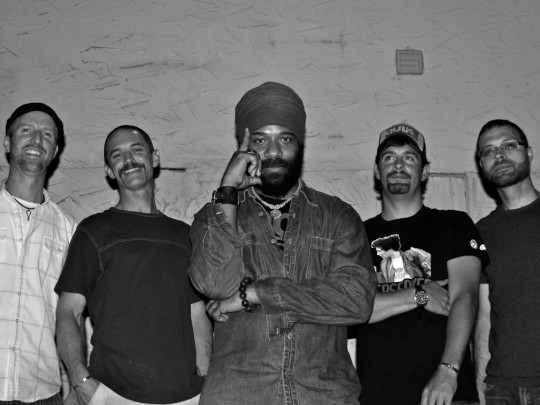
They’ve been compared to everyone from Steely Dan and Incubus to Umphreys McGee, but Banooba will . . . soon be the standard of comparison. Taking cues from all of their influences, including funk, jazz, reggae and rock, Banooba is the latest hybrid to successfully incorporate all of these elements into their own signature sound.
Over the years, Banooba has become known for their high-energy live performance which is guaranteed to keep you moving all night long. No matter what type of music you are into, you are going to have a good time at a Banooba show. “These guys groove like it’s their last day on earth, with irresistible songs and wicked musicianship,” says Dan Brown of Good Times Magazine.
Since their inception, Banooba has performed at a variety of clubs and colleges around the Northeast as well as the US Virgin Islands, where they were quickly adopted by the locals and paved the way for the development of a USVI music scene. They have also performed national tours of both the UK and Costa Rica, and their music has found itself in rotation on numerous college and commercial radio stations (both in the US and abroad) as well as on Sirius Satellite’s Jam On station where their song “Sinora” spent a month at #1.
Following a nearly two-year hiatus due to the departure of their lead singer, Banooba hooked up with singer Jason Murden. There was an instant connection and the band began cranking out new music. After a test run with Murden quickly won over the Banooba faithful in the Virgin Islands, the band knew it was time for their hiatus to come to an end.
Now, this never-say-die band is back with new material and ready to take the music scene by storm. With a new studio album currently in the works, Banooba is once again bringing their high-energy live performance to clubs, colleges and festivals around the Northeast and beyond Don’t miss it!
Learn More
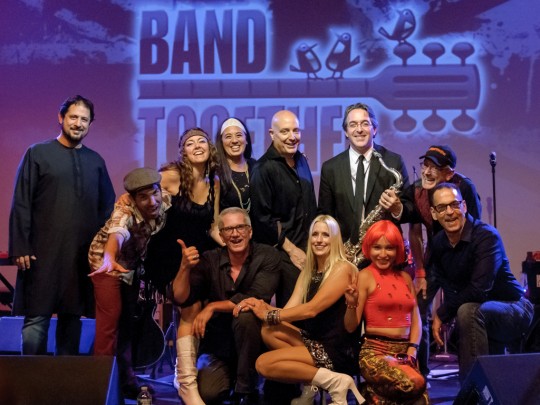
Fuzz and Cyrus Madan from Deep Banana Blackout, vocalists Tracy James, Jean Marie Rivera, Carrie . . . Sangiovanni from Caravan Of Thieves, drummer Mike Marble, saxophonist Jim Clark
join Band Together founders Jerry Vigorito and Rob Fried for “British Invasion” Beatles, Stones, Zeppelin, Clapton and the Who!
Band Together CT, was founded in the Spring 2006 at the local Grange in Weston.
It has grown into the “go to musical event” receiving numerous “Best Of” awards and positive press and notoriety.The NY Times quotes “ The feel good nature of the Band Together thing is Indescribable”
Band Together CT unites a network of talented musicians and artists with organizations raising funds for families in need of a helping hand. Producing themed benefit concerts, each one is a unique and wonderful testament to the generosity of the human spirit.They have worked with Meryl Streep and the late Paul Newman in an effort to save Connecticut farmland.Band Together Ct featured a variety of Local talent along with artists such as Rock and Roll Hall of Fame Artists John Oates and Ronnie Spector.
Founder Rob Fried and Jerry Vigorito went on to receive the “2013 Encore Artists of the Year” by Fairfield Theatre Co. Band Together Ct also has been recognized by CT Governor R. Jodi Rell and both National and Connecticut Legislature.
To date Band Together CT helped raise over $1.4 ml for local charities and families.
Learn More
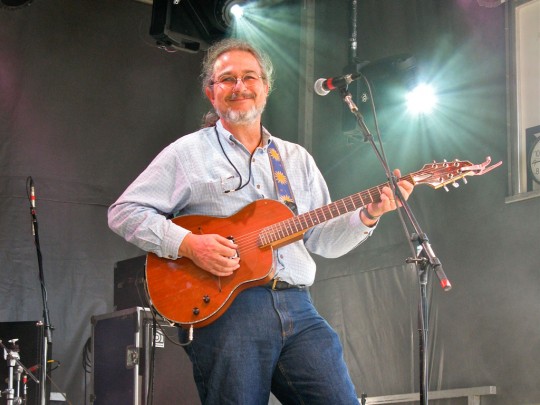
He is a guitarist, and is known for incisive, literate songwriting. He is also noted for his music . . . loop work, often creating spontaneous compositions in performance. He is the co-author of the book Playing in the Band: An Oral and Visual Portrait of the Grateful Dead, and the host of the weekly syndicated radio show The Grateful Dead Hour. He currently co-hosts a radio show with Gary Lambert on Sirius-XM called “Tales from the Golden Road”, a call in show about the Grateful Dead.
But “skilled solo performer” fills only one page of David’s artistic resume. Besides playing in all sorts of bands through the years, from the fondly remembered Reptiles to The Known Unknown, he’s also sat in with an amazing range of fine musicians, including Phil Lesh, Donna the Buffalo, Henry Kaiser, New Riders of the Purple Sage, Ollabelle, the late great Vassar Clements, Jim Lauderdale, The String Cheese Incident, Peter Rowan, moe., eKoostik Hookah, and the Rumpke Mountain Boys. He has also written songs with a host of others, including Jim Page, Robert Hunter, and Peter Rowan.
David’s live repertoire is peppered with an incredibly broad (and unpredictable) range of cover tunes by old and new musical heroes. Pressed to list some of his songwriting influences not too long ago, David reeled off Bob Dylan, The Beatles, Neil Young, Jackson Browne, Steve Goodman, John Prine, CSN, Willie Nelson, Merle Haggard, Holland-Dozier-Holland, Mann & Weil, Carole King, Gram Parsons, Elton John & Bernie Taupin, Robbie Robertson, and the Grateful Dead – quite a list. He’ll also tell you that in recent years, as he’s toured extensively and played with many superb musicians at festivals and in other settings, along the way discovering a whole new generation of songwriters and players who are inspiring him.
As both a player and a fan, he understands the indefinable transformative power of music: how it feeds our very life-force, bonds us together in obvious and unseen ways, teaches us, heals us, makes us better citizens of this fragile planet. A David Gans “solo electric” performance is likely to consist of several elements; country-blues-style fingerpicking, loop-based improvisations, sweetly sung ballads (originals or covers), Grateful Dead covers reinterpreted to suit his voice and guitar, wry observations of the music festival subculture and the larger world, soulful and passionate political-commentary, and favorites from the folk rock canon of the last 50 years. Mix and match, it’s never the same show twice, but always worth a listen.
This fall will see the publication of “This Is All a Dream We Dreamed: An Oral History of the Grateful Dead,” a collaboration with Blair Jackson; and a solo album of Grateful Dead songs titled “It’s a Hand-Me-Down.”
Learn More

One of the longest running Vibes Traditions takes place Sunday morning on the main stage with the . . . World Peace Prayer Ceremony. All are invited to celebrate the countries of the world, and the universal message: May Peace Prevail On Earth!
The World Peace Prayer Ceremony is a global celebration of the oneness of life and the human family. With united hearts and minds, participants of the Ceremony are invited to invoke prayers for peace to prevail in the countries and regions of the world. It is a moving ceremonial ritual rising above national boundaries, religion and ideologies giving expression to the universal wish for peace and harmony which lies at the core of every human heart.
Please visit the World Peace Sanctuary booth to register your kids in the international Peace Pals Art Exhibition and to learn about free peace art projects! Join us Sunday morning at 11:40 to carry a flag in the World Peace Flag Ceremony on the main concert field, and help spread a message of love and peace!
Learn More
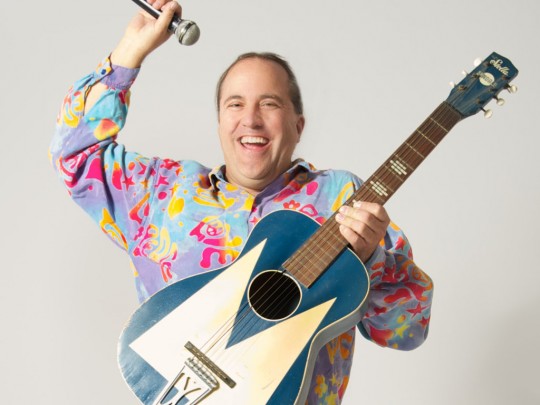
Andy “The Music Man” Morse is a popular children’s musician renowned for the special way he connects . . . with his audiences. A talented guitarist, mandolin player and songwriter, Andy mingles traditional and original songs and novelty, delighting and involving kids through sing-a-longs, dancing, play-acting and storytelling.
From the moment he appears, Andy reels in the kids and holds their attention. He has a gift for establishing rapport, making each child feel comfortable participating in calling out rhymes or acting out animals or the alphabet. With insights and humor arising from the interaction and inventiveness of the children, Andy’s performances often reach fresh and funny heights.
While all the fun is going on, Andy is also educating. Through gentle lessons that never turn into lectures, he talks and sings about things that are important to children as individuals – brushing teeth, sharing, using good manners, helping out at home – and as members of the greater community: taking care of the Earth and each other.
Andy appears throughout the Capital Region of New York State, where he is based, as well as in the Northeast and New England. Making his mark around the country, he is an in-demand director of Children’s Music Programming at national musical festivals that attract 15,000 to 20,000 persons in Florida, California, Maine, and Connecticut.
Learn More
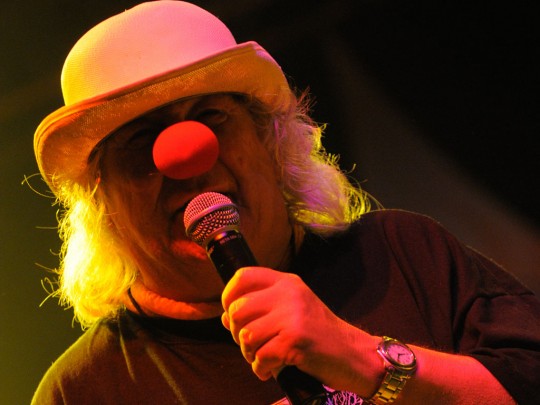
Did you know the Grateful Dead had their own official clown? Of course they did, and who else could . . . it possibly be but the one, the only, Wavy Gravy? Returning once again as Emcee and Master of Ceremonies is Wavy Gravy, the original prankster with a purpose. From war protester, to Woodstock stage announcer, to clown for peace, to Seva Foundation and Camp Winnarainbow co-founder, Wavy has been spreading laughter and light for decades.
Back when he was still known as Hugh Romney, he stood on the stage of the original Woodstock festival and announced, “What we have in mind is breakfast in bed for 400,000!” Just two weeks after that, Hugh Romney became Wavy Gravy, thanks to B.B. King bestowing the nickname on him at the Texas International Pop Festival in 1969.
He may be best known to millions as a cosmic cut-up and the inspiration for a Ben & Jerry’s ice cream flavor, “I am an activist clown and former frozen dessert,” he says, but it is because of his good work on behalf of the planet and its least fortunate residents that Wavy Gravy has achieved his own brand of sainthood. His friend and satirist Paul Krassner has called him “the illegitimate son of Harpo Marx and Mother Teresa.” Wavy says, “Some people tell me I’m a saint, I tell them I’m Saint Misbehavin’.”
Learn More